 listicle
Affordable Scratch and Dent Appliances: Smart Savings
Table of Contents
- Why Shoppers Choose Scratch and Dent Appliances
- Scratch and Dent vs. Refurbished vs. Used: What's the Difference?
- How to Inspect Scratch and Dent Appliances Before You Buy
- Open Box Appliance Deals: Same Quality, Lower Price
- What to Look for in the Warranty and Return Policy
- Types of Appliances Available and Typical Savings
- Your Scratch and Dent Buyer's Checklist
- Conclusion: Where to Find Affordable Scratch and Dent Appliances
- Frequently Asked Questions
Last Updated: September 4, 2026
Why Shoppers Choose Scratch and Dent Appliances
A scratch and dent appliance is a brand-new, factory-fresh unit with cosmetic imperfections from shipping or handling. These blemishes do not affect function but lower the retail value, translating directly into savings.
The biggest misconception is that these are damaged goods. Most carry only minor marks on the sides or back, invisible once installed. For outfitting a full kitchen or laundry room, savings on multiple units are substantial.
Below, we will show you exactly how to evaluate affordable scratch and dent appliances with confidence, what cosmetic flaws are acceptable, and which functional checks matter most before you commit.

Scratch and Dent vs. Refurbished vs. Used: What's the Difference?
Understanding the grading system is the single most important step in appliance shopping. Scratch and dent units are new, never-owned appliances with surface blemishes. Refurbished units were previously owned or returned, then repaired and tested. Used appliances have no quality assurance standard, meaning you buy them strictly as-is.
| Category | Condition | Warranty | Risk Level |
|---|---|---|---|
| Scratch and Dent | New, cosmetic damage only | Full manufacturer warranty | Low |
| Refurbished | Pre-owned, repaired and tested | Varies by seller | Medium |
| Used | Pre-owned, untested | None | High |
The distinction drives both price and protection. A scratch and dent refrigerator carries the same full manufacturer warranty as a pristine model, while a used unit offers zero recourse if the compressor fails. Factory seconds and closeouts fall into this category when new but blemished.
How to Inspect Scratch and Dent Appliances Before You Buy
Learning how to inspect scratch and dent appliances is straightforward once you know what to look for. Never skip the inspection, even on a deep discount. A thorough check takes about ten minutes and covers appearance and function.
Visual Identification Guide: What You're Actually Looking At
Most buyers lack a clear picture of what "scratch" versus "dent" versus "scuff" means on a real unit. Here is a practical field guide to the damage you will encounter, ranked by how much it should concern you.
Surface scratches on stainless steel. These appear as fine, light lines, often from a shipping strap. Run your fingernail across the scratch. If it does not catch, the scratch is in the clear coat only and can be minimized with a non-abrasive stainless steel cleaner applied in the direction of the grain. A scratch that catches your nail has cut into the metal and will not buff out, but it is still purely cosmetic unless on the front face at eye level.
Dents on the side or back panels. These are the most common and benign, almost always invisible once installed between cabinets or against a wall. Press gently on the dent. If the metal is firm and does not flex or feel sharp at the edges, structural integrity is intact. The exception is a dent that has sharply creased the metal, creating a potential weak point for vibration damage.
Scuffs and rub marks. These appear as dull, cloudy patches on the finish, often on the top or front edges. They come from protective plastic film being partially peeled and re-stuck during handling. Scuffs are the most superficial form of damage and rarely warrant more than a small discount.
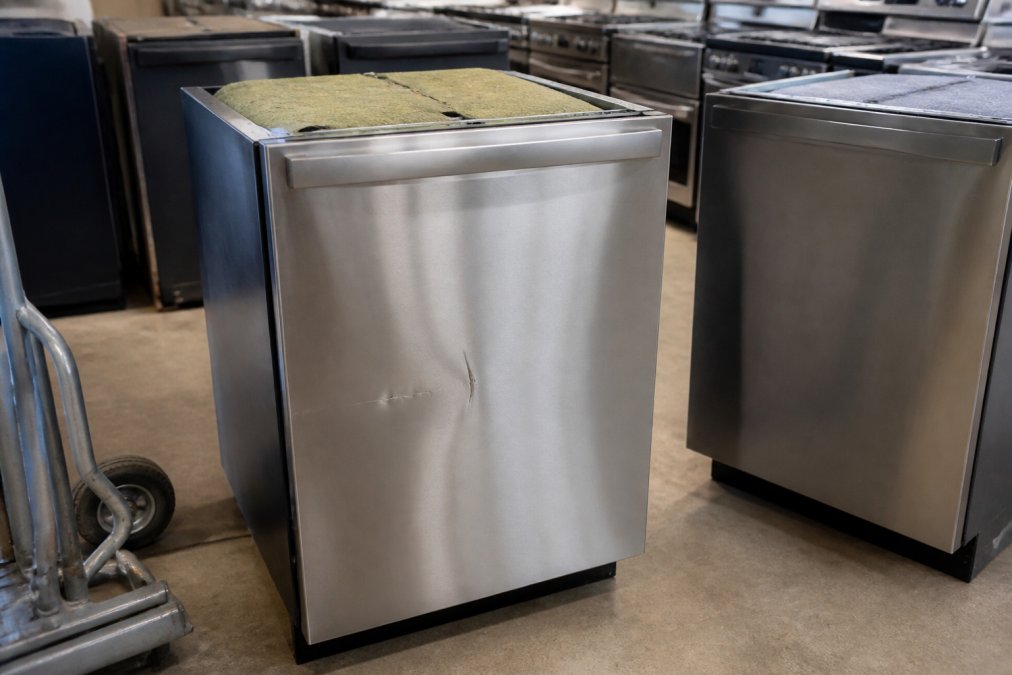
Dents on the front face or door. This is where the discount gets serious and where you must be most careful. A front-face dent is visible every day and should command a significantly larger discount than a side dent. Before accepting it, open and close the door several times. Confirm the dent has not pushed inward enough to interfere with the door seal or hinge alignment. If the door closes flush and the seal is tight, the dent is a cosmetic trade-off for a steeper price cut.
Damage to the interior liner. Reject any unit with cracks, punctures, or deep gouges in the interior liner of a refrigerator or freezer. The liner is the barrier that keeps cold air in and moisture out. A compromised liner can lead to ice buildup, temperature fluctuations, and eventual failure of the sealed system. This is not a cosmetic issue; it is a functional one.
Damage to the control panel or display. Any crack, chip, or deep scratch on the control panel is an automatic reject. The control panel houses the electronics that run the appliance. A visible impact to this area may have damaged internal components even if the display still lights up during a test cycle.
Functional Checks That Matter
Beyond cosmetics, verify the appliance works. Open refrigerator doors and confirm seals are tight and the interior light activates. For washers and dryers, check that the drum spins freely and the door latch engages. Run the control panel through its cycles to ensure no error codes appear. Dishwashers should have intact racks and a firmly closing door.
How Damage Severity Translates to Discounts
While pricing varies by model and dealer, discount tiers typically follow damage location and visibility. Side and back dents on refrigerators and laundry pairs command the smallest discount, often 10 to 20 percent off current retail (consumerreports.org). Front-face dents, especially on dishwashers and ranges, can command 30 percent or more. Scratches alone usually produce a modest discount unless on the front glass of an oven door. Ask the dealer directly how the price was derived and compare it against the current street price, not the MSRP.
Open Box Appliance Deals: Same Quality, Lower Price
Open box appliance deals are a subcategory of scratch and dent inventory deserving special attention. These are units returned within a store's return window, often because a customer changed their mind about color or size. The appliance was delivered, unboxed, and sent back, meaning it has been lightly handled but typically shows almost no wear.
The appeal is simple: a fully tested unit at a discounted rate without visible blemishes. Open box inventory turns over quickly, so availability fluctuates week to week. Shoppers who need a specific model in a hurry should check with their local dealer about current stock.
What to Look for in the Warranty and Return Policy
The warranty is where scratch and dent shopping gets tricky. A true factory unit should carry the same full manufacturer warranty as a new appliance, typically one year for parts and labor (the FTC). However, some retailers sell "scratch and dent" units that are actually floor models or customer returns with only a store warranty.
Ask three questions before you buy. First, is the manufacturer warranty active from the date of my purchase? Second, does the store offer a return window if the unit arrives with unexpected damage? Third, who handles warranty service, the manufacturer or the store? According to the Federal Trade Commission guidance on warranty protections, you have the right to see the full warranty terms in writing before you make a purchase. A dealer that hesitates to put warranty terms in writing is a red flag. The Appliance Wizard includes the manufacturer warranty on all new scratch and dent units, and our in-house service team handles repairs directly, so you never deal with a third-party call center.
Types of Appliances Available and Typical Savings
Scratch and dent inventory spans nearly every major appliance category, though the mix shifts based on what gets damaged in transit. Refrigerators are the most common find, followed by washers and dryers, dishwashers, stoves, and microwaves. Laundry pairs are particularly popular because a side dent on a washer is invisible once pushed into a closet or utility room.
Savings vary based on the severity of the blemish and the original MSRP. Minor marks on a refrigerator side might knock a small percentage off, while a visible dent on a dishwasher front door can produce a much steeper discount. Compare the scratch and dent price against the current retail price, not the often-inflated MSRP. Dealers who price against actual street prices offer genuine savings; those who anchor to a high MSRP do not.
How to Maintain and Protect Your Cosmetic-Damaged Unit
A scratch and dent appliance is new and subject to the same wear and tear as any other unit. The difference is that you already know where the weak spot is.
For stainless steel scratches: Clean with a stainless steel cleaner and a microfiber cloth, working in the direction of the grain. Do not use abrasive pads or chlorine-based cleaners, which will strip the protective coating and make the scratch more visible. For deeper scratches that catch a fingernail, a repair kit with a filler compound can smooth the surface, though the color match is rarely perfect.
For dents: A dent itself requires no maintenance, but the risk is that the area becomes a point of weakness over time. Check the dented area every few months, especially after a move or if you notice new vibrations. If the dent is on a refrigerator side panel, ensure the unit is level, as an unlevel refrigerator vibrates more and can stress a creased panel. If the dent is on the front of a dishwasher or range, the main concern is moisture causing rust. Wipe the area dry after cleaning and apply touch-up paint if bare metal is exposed.
For scuffs and rub marks: These are the easiest to maintain. A scuff is typically a transfer of material from packaging or another surface onto the appliance finish. A mild cleaner and a soft cloth will usually remove it entirely. If the scuff has dulled the finish, a stainless steel polish will restore the shine.
For units with damage near the door hinge: If you purchased a unit with a dent near a hinge, pay attention to how the door opens and closes over the first few weeks. A dent near the hinge can cause the door to sit slightly off, putting uneven pressure on the seal. If the door becomes harder to close or the seal does not make full contact, contact the dealer immediately.
What to Do If the Damage Worsens
A cosmetic blemish acceptable at purchase can become a functional issue if it worsens. If you notice a dent getting deeper, a scratch starting to rust, or a seal failing near a damaged area, document the change with photos and contact the dealer or manufacturer. The full manufacturer warranty covers functional failures, not cosmetic appearance, so demonstrate that the worsening condition affects performance.
Your Scratch and Dent Buyer's Checklist
Use this checklist when you visit a showroom or schedule a delivery to ensure you cover every critical point.
- Confirm the unit is new, not refurbished or a floor model
- Inspect all visible sides for dents, scratches, and scuffs
- Check door seals, hinges, and alignment on refrigerators and ovens
- Verify the interior is clean and free of damage or missing shelves
- Run the control panel through a test cycle to check for error codes
- Confirm the full manufacturer warranty is active from your purchase date
- Get the return policy and any restocking fees in writing
- Compare the price against the current retail price of the same model
- Ask about delivery, installation, and haul-away of your old unit
- Verify the serial number matches the unit and has not been registered
Conclusion: Where to Find Affordable Scratch and Dent Appliances
Finding affordable scratch and dent appliances comes down to working with a dealer transparent about condition, warranty, and pricing. The right store will let you inspect the unit yourself, explain exactly where the damage is, and back the purchase with the full manufacturer warranty. A local, family-owned outlet with an in-house service team offers an advantage big-box chains cannot match.
At The Appliance Wizard, our showrooms in Marion and Carbondale carry a rotating selection of refrigerators, washers, dryers, dishwashers, stoves, and microwaves from top manufacturers. Every scratch and dent unit is fully tested, and our factory-trained technicians handle installation and any future warranty service. We also offer flexible financing and a price match guarantee so you can upgrade your home without the stress. Visit us online at www.theappliancewizard.com to browse current inventory, or stop by a showroom to see today's deals in person.
Frequently Asked Questions
Is it worth buying scratch and dent appliances?
Yes, for most shoppers. Cosmetic imperfections like minor dents, scratches, or scuffs do not affect how the appliance runs. You can save on the purchase while getting a fully tested unit with a manufacturer warranty. The savings are especially worthwhile for laundry rooms, garages, basements, or rental properties where appearance matters less than function and price.
Do scratch and dent appliances come with a manufacturer's warranty?
Most reputable retailers sell scratch and dent units with the same full manufacturer warranty as brand-new models. The cosmetic damage does not void coverage. Before buying, confirm the warranty start date and whether it covers parts and labor. Ask the retailer to put the warranty terms in writing so you have clear protection if something goes wrong.
What is the difference between scratch and dent and refurbished appliances?
Scratch and dent appliances are brand-new units that received cosmetic damage during shipping, handling, or display. They have never been used. Refurbished appliances were previously owned or returned, then repaired and tested. Scratch and dent units typically carry full manufacturer warranties, while refurbished units often have shorter third-party warranties. If you want the lowest risk, scratch and dent is the safer choice.
What should you inspect before buying a scratch and dent appliance?
Check every visible surface for dents, scratches, and dings, and confirm the damage is only cosmetic. Open doors and drawers to verify they align and seal properly. Inspect the interior for cracks or missing shelves. Ask whether the unit has been plugged in and tested. Confirm the model number and that all included accessories, like racks and grates, are present before delivery.
How much can you typically save on scratch and dent appliances?
Discounts on scratch and dent appliances vary depending on the severity and location of the damage. Damage on the side or back of a unit usually earns a smaller discount than damage on the front door. Ask the retailer how they price their discounted units and whether they offer open box appliance deals for even better value.
Frequently Asked Questions
Q: Is it worth buying scratch and dent appliances?
A: Yes, for most shoppers. Cosmetic imperfections like minor dents, scratches, or scuffs do not affect how the appliance runs. You can save on the purchase while getting a fully tested unit with a manufacturer warranty. The savings are especially worthwhile for laundry rooms, garages, basements, or rental properties where appearance matters less than function and price.
Q: Do scratch and dent appliances come with a manufacturer's warranty?
A: Most reputable retailers sell scratch and dent units with the same full manufacturer warranty as brand-new models. The cosmetic damage does not void coverage. Before buying, confirm the warranty start date and whether it covers parts and labor. Ask the retailer to put the warranty terms in writing so you have clear protection if something goes wrong.
Q: What is the difference between scratch and dent and refurbished appliances?
A: Scratch and dent appliances are brand-new units that received cosmetic damage during shipping, handling, or display. They have never been used. Refurbished appliances were previously owned or returned, then repaired and tested. Scratch and dent units typically carry full manufacturer warranties, while refurbished units often have shorter third-party warranties. If you want the lowest risk, scratch and dent is the safer choice.
Q: What should you inspect before buying a scratch and dent appliance?
A: Check every visible surface for dents, scratches, and dings, and confirm the damage is only cosmetic. Open doors and drawers to verify they align and seal properly. Inspect the interior for cracks or missing shelves. Ask whether the unit has been plugged in and tested. Confirm the model number and that all included accessories, like racks and grates, are present before delivery.
Q: How much can you typically save on scratch and dent appliances?
A: Discounts on scratch and dent appliances vary depending on the severity and location of the damage. Damage on the side or back of a unit usually earns a smaller discount than damage on the front door. Ask the retailer how they price their discounted units and whether they offer open box appliance deals for even better value.