 listicle
Best Kitchen Appliance Packages 2026: A Buyer's Guide
Table of Contents
- Best Kitchen Appliance Packages 2026: The Shortlist
- Why Buy an Appliance Bundle? Pros and Cons of Appliance Packages
- How to Choose Kitchen Appliances for Your Remodel
- Budget vs. Premium Appliance Packages
- Energy Efficiency and Smart Connectivity
- Installation, Delivery, and Long-Term Support
- Conclusion: Building Your Perfect Kitchen Package
- Frequently Asked Questions
Last Updated: September 6, 2026
Best Kitchen Appliance Packages 2026: The Shortlist
Buying a kitchen appliance package in 2026 is one of the smartest ways to save on a full remodel, but the sheer number of options makes it easy to overspend on features you will never use. A coordinated suite typically costs less than buying each piece separately and guarantees a consistent finish. At The Appliance Wizard, we help homeowners in Southern Illinois build these packages, and a common mistake we see is choosing appliances before measuring the space or setting a realistic budget.
The best kitchen appliance packages 2026 buyers should consider are the ones that match their cooking habits, kitchen dimensions, and long-term ownership plans. Below, we show you how to evaluate a multi-piece set against your layout, finish preferences, and budget, so you can avoid the costly mismatches that plague most first-time buyers.
Why Buy an Appliance Bundle? Pros and Cons of Appliance Packages
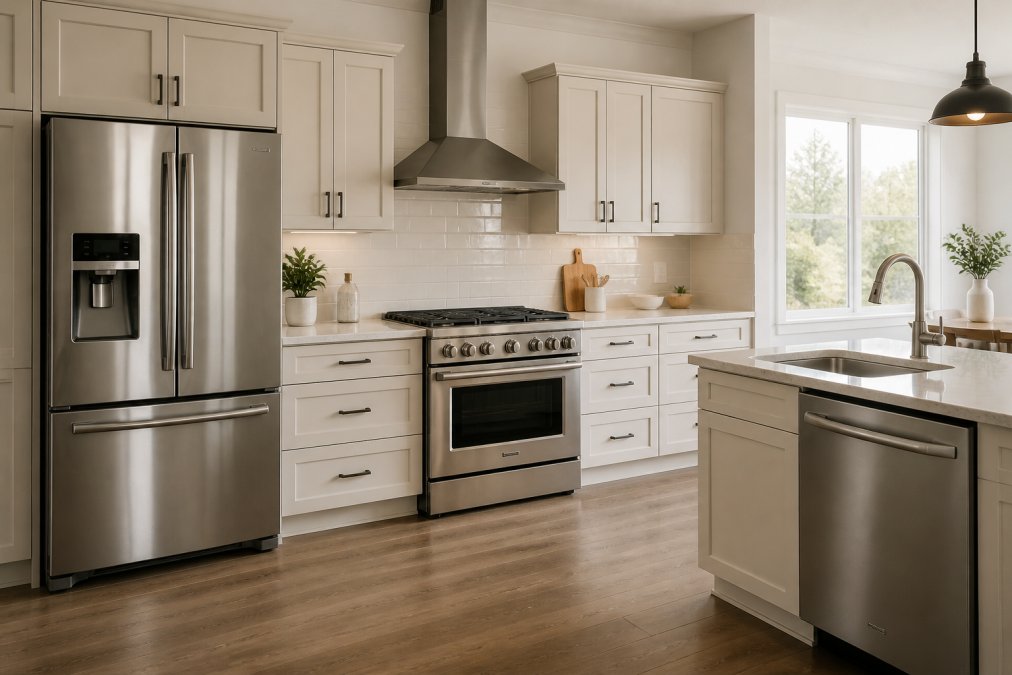
The pros and cons of appliance packages come down to a tradeoff between upfront savings and design flexibility. Bundling a refrigerator, range, dishwasher, and over-the-range microwave into one purchase typically unlocks manufacturer rebates and bundle savings that single-item purchases do not.
You also simplify delivery coordination, installation scheduling, and warranty management, since one retailer handles the entire order. The tradeoff is that you sacrifice the ability to mix brands for best-in-class performance in each category, and you may pay for features you do not need.
How to Choose Kitchen Appliances for Your Remodel
Choosing kitchen appliances starts with two measurements: the physical dimensions of your cutouts and the depth of your cabinets. Standard-depth refrigerators sit flush with cabinetry, while counter-depth models trade interior storage for a built-in look. Measure the width, height, and depth of every opening before you fall in love with a specific suite.
Matching the Suite to Your Kitchen Layout
Your layout dictates which appliance dimensions you can accommodate. A 30-inch range is the industry standard for most residential kitchens, but a 36-inch model may require cabinet modifications that add hundreds to your remodel cost. For a galley kitchen, look for a counter-depth refrigerator and a slide-in range that maximizes counter space. For a large island layout, you have more room for a standard-depth refrigerator with higher cooking capacity.
Finish and Aesthetic Consistency
Stainless steel remains the dominant finish, but not all stainless is equal. Fingerprint resistant coatings are worth the modest upcharge if you cook daily or have young children, and they dramatically reduce visible smudges. Match your finish across all visible surfaces, and check whether the package includes a panel-ready dishwasher that accepts your cabinet fronts for a seamless built-in appearance.
Layout-Specific Fit: Galley, Island, and Open-Concept Kitchens
Most package guides stop at dimensions, but the shape of your kitchen determines whether a suite will actually work in your space. Here is how to evaluate a package against the three most common residential layouts:
Galley Kitchens (Corridor Layouts)
Galley kitchens have two parallel counter runs with a walkway between them. The critical constraint is aisle width: the National Kitchen and Bath Association recommends a minimum of 42 inches for a single cook and 48 inches for multiple cooks. A standard-depth refrigerator with a 36-inch depth can eat into that clearance. For galley layouts, prioritize:
- Counter-depth refrigerators (typically 24 to 30 inches deep) to preserve aisle space
- Slide-in or freestanding ranges rather than drop-in models, since they do not require custom cabinetry
- A dishwasher with a recessed handle or panel-ready front to avoid snagging in tight quarters
Island and Open-Concept Kitchens
Open-concept and island layouts offer more flexibility, but they introduce a different problem: visual sightlines. When your kitchen opens into the living or dining area, the side panels of your appliances become visible. Standard-depth refrigerators with exposed metal sides can look unfinished. In these layouts, consider:
- Panel-ready refrigerators and dishwashers that accept cabinet fronts, creating a seamless furniture-like appearance
- Built-in or integrated appliances that sit flush with cabinetry
- A 36-inch range or cooktop if your island provides the counter space for prep, since the larger cooking surface becomes a focal point
L-Shaped and U-Shaped Kitchens
These layouts create a work triangle between the sink, range, and refrigerator. The constraint here is corner clearance. A French-door refrigerator with a 36-inch width may not allow the doors to open fully if the unit sits adjacent to a corner cabinet. Measure the swing radius of both refrigerator doors and the dishwasher door before committing to a package. A common pattern is that buyers discover the dishwasher door collides with the range handle when both are open.
The 36-Inch Range Decision
A 36-inch range is the single most common upgrade in premium packages, but it carries hidden costs beyond the unit price. Standard 30-inch ranges fit between 33-inch and 36-inch cabinet openings. Moving to 36 inches typically requires widening the cabinet cutout, which means new countertop sections, potentially new upper cabinetry, and a custom backsplash repair. The total remodel cost for a 36-inch range can run $800 to $1,500 beyond the appliance price. If your layout cannot accommodate the wider cutout without structural changes, a 30-inch range with a high-output burner package delivers comparable cooking performance for most home cooks.
Ventilation Requirements by Layout
Your range hood or ventilation system must match both your range width and your kitchen's configuration. A 36-inch range requires a hood rated for at least 400 CFM for electric cooking, and 600 CFM or higher for gas. In an open-concept layout, the hood becomes a visible design element, so verify that the package's over-the-range microwave or separate hood matches your ceiling height and ducting route. Island layouts require downdraft ventilation or an island-mounted hood, which adds $500 to $1,200 to the overall project cost. Many package deals do not include ventilation, so factor this into your total budget.
Budget vs. Premium Appliance Packages
Budget appliance packages prioritize durability and core performance, while premium packages add convection cooking, smart connectivity, and quieter operation. A budget-friendly suite typically includes a standard refrigerator, a coil or radiant electric range, and a dishwasher with a basic wash cycle. These packages suit landlords, rental properties, and first-time homeowners who need dependable function without paying for advanced features.
Premium packages justify their higher price point through measurable differences: a convection range cooks evenly and faster, a dishwasher operates quietly enough to run during conversation, and the refrigerator offers better temperature stability and storage flexibility. The real differentiator is long-term cost of ownership. Energy-efficient models carry a higher upfront price but reduce monthly utility bills and often qualify for rebates. A mid-tier package with an ENERGY STAR certified refrigerator and a convection range can deliver a significant portion of the premium experience at a lower cost.
The 10-Year Cost of Ownership: Beyond the Sticker Price
Comparing package prices side-by-side misses the largest cost driver: what each suite costs to operate and maintain over its useful life. Evaluate any package by calculating total cost of ownership (TCO) across three components: purchase price, annual energy consumption, and expected repair frequency.
Energy Consumption: The Quiet Monthly Drain
Refrigerators run 24 hours a day, making them the single largest energy consumer in most kitchens. A typical 20-cubic-foot refrigerator from 2010 consumes roughly 600 kilowatt-hours (kWh) per year (energy.gov). An ENERGY STAR certified model from 2026 consumes approximately 300 to 350 kWh annually for the same capacity. At the national average electricity rate of about 16 cents per kWh, that difference is roughly $40 to $50 per year. Over a 15-year lifespan, the efficient refrigerator saves $600 to $750, often exceeding the upfront price premium.
Dishwashers and ranges contribute less to the monthly bill, but the gap still matters. An ENERGY STAR dishwasher uses about 3.5 gallons per cycle versus 5 to 7 gallons for a non-certified model, saving $20 to $35 per year at average water and sewer rates. A convection range reduces cooking time by up to 25 percent compared to a conventional oven, which translates to modest savings that compound over a decade of daily use.
Repair Frequency and Service Costs
Budget packages typically use simpler mechanical components, coil burners, mechanical timers, and basic water valves, which fail less often but offer fewer features. Premium packages add compressors with variable-speed drives, electronic control boards, and smart modules, which improve performance but introduce more potential failure points. A control board repair on a premium refrigerator can be expensive, potentially costing $300 to $600 in parts and labor. Budget models with mechanical controls rarely need board replacements.
However, premium units often include longer warranties. Many manufacturers offer a 10-year sealed system warranty on refrigerators and a lifetime warranty on the porcelain interior of ranges, while budget packages typically cover the sealed system for 5 years. When comparing packages, check the warranty language for three items: the sealed system, the electronic control board, and the labor coverage period. A package with a 10-year parts warranty but only 1 year of labor coverage can still result in a service call if a component fails after the labor coverage period.
A Practical Calculation Framework
To compare two packages on TCO, use this simple framework:
- Purchase price: The delivered and installed cost of the full suite.
- Annual energy cost: Multiply each unit's estimated annual kWh by your local electricity rate. ENERGY STAR's product finder provides model-specific estimates.
- Repair reserve: Set aside 1 to 2 percent of the purchase price per year for out-of-warranty repairs. Premium packages with longer warranties may justify a lower reserve.
- Rebates and incentives: Check your local utility and state energy office for rebates on ENERGY STAR certified appliances. Many utilities offer $50 to $150 per qualifying refrigerator, and some states add incentives for heat-pump dryers or induction ranges.
When Budget Wins, and When Premium Pays Off
A budget package wins on TCO when you plan to keep the appliances for fewer than 7 years, when your utility rates are below the national average, or when the suite goes into a rental property. A premium package wins on TCO when you plan to stay in the home for 10 or more years, when you cook daily and rely on convection or induction performance, and when the energy savings plus rebates close the upfront gap within 3 to 5 years.
| Cost Factor | Budget Package | Mid-Range Package | Premium Package |
|---|---|---|---|
| Typical upfront price | $1,500-$2,500 | $3,000-$5,000 | $6,000-$12,000+ |
| Estimated annual energy cost | $180-$250 | $120-$180 | $90-$140 |
| Sealed system warranty | 5 years | 5-10 years | 10 years |
| Control board warranty | 1 year | 1-2 years | 2-5 years |
| 10-year TCO estimate | $3,500-$5,500 | $4,500-$7,000 | $7,500-$14,000 |
| Best For | Rentals, short-term ownership | Most family kitchens | Long-term homeowners, heavy cooks |
Energy Efficiency and Smart Connectivity
Energy efficiency ratings directly affect both your utility bills and your environmental footprint, making them a core consideration for any kitchen appliance package. The ENERGY STAR program, administered by the U.S. Environmental Protection Agency, certifies appliances that meet strict efficiency criteria, and choosing certified models can reduce your kitchen's energy consumption substantially compared to non-certified units. For 2026, look for refrigerators with advanced compressors and dishwashers with soil sensors that adjust water usage to the load.
Smart connectivity has moved from a luxury feature to a practical consideration for many homeowners. A refrigerator with Wi-Fi lets you monitor temperature remotely and receive alerts when the door is ajar, while a smart dishwasher can start a cycle from your phone during off-peak energy hours. The catch is that smart features add complexity and cost, and they only deliver value if you actually use them. The U.S. Department of Energy's appliance guidance recommends focusing on energy performance first and treating smart features as a secondary consideration, since connectivity does not improve efficiency on its own.
| Consideration | Budget Package | Mid-Range Package | Premium Package |
|---|---|---|---|
| Refrigerator | Standard-depth, manual defrost | Counter-depth, fingerprint resistant | Smart, French door, energy star |
| Range | Radiant electric or basic gas | Convection oven | Convection + smart controls |
| Dishwasher | Standard cycles, higher noise | Soil sensors, lower noise | Smart, whisper-quiet operation |
| Best For | Rentals, first homes | Most family kitchens | High-end remodels |
Installation, Delivery, and Long-Term Support
Installation and delivery logistics often determine whether a kitchen appliance package feels like a bargain or a headache. Measure your doorways, hallways, and stairwells before ordering, since a standard-depth refrigerator may not fit through a narrow opening, and confirm whether the retailer includes haul-away of your old units. Professional installation matters most for ranges and dishwashers, where improper hookups can void the manufacturer warranty.
Long-term support is where local service separates itself from big-box transactions. When you buy a package from a retailer with an in-house repair team, you have a single point of contact for warranty claims, troubleshooting, and replacement parts. The Appliance Wizard, for example, pairs every package sale with factory-trained, certified technicians who handle installation, in-home repair, and maintenance across most major makes and models, so your relationship does not end at delivery.
Conclusion: Building Your Perfect Kitchen Package
The best kitchen appliance packages 2026 are the ones that fit your space, your cooking style, and your budget, in that order. Start by measuring your kitchen and confirming your layout constraints, then decide on a finish and an energy efficiency target before you compare prices. A package saves you money only if every unit in it earns its place in your home.
Building the right kitchen appliance package is a decision that benefits from expert guidance. At The Appliance Wizard, our team helps Southern Illinois homeowners match the right suite to their layout, with professional installation, flexible financing, and ongoing repair support from our certified technicians. Visit our showrooms in Marion or Carbondale, or browse our current inventory online to find a package that fits your remodel.
Frequently Asked Questions
Is it cheaper to buy all appliances in a bundle?
Yes, buying a kitchen appliance package is almost always cheaper than purchasing each unit individually. Retailers and manufacturers offer bundle savings on multi-piece sets because it simplifies their inventory and logistics. You'll typically see the most significant discounts on 4-6 piece suites, and it simplifies coordination since all appliances arrive together. However, compare the total bundle price against the sum of individual sale prices, as a promotional price on a single unit can sometimes make a custom mix more competitive.
What should I look for when comparing kitchen appliance suites?
Start with the core appliances: refrigerator, range, dishwasher, and over-the-range microwave. Check for Energy Star certification to estimate long-term operating costs. Measure your space for counter-depth versus standard-depth refrigerators and verify cutout dimensions for ranges. Match the finish across all units for aesthetic consistency, and note whether the suite offers smart connectivity. Finally, confirm the manufacturer warranty and the availability of local installation service, which protects your investment and ensures proper setup.
Are smart kitchen appliance packages worth the extra cost?
Smart suites add value if you will use the features. Remote diagnostics let a technician identify issues before a service visit, and you can preheat an oven or adjust a fridge temperature from your phone. The premium is justified for busy households that value convenience. But if you rarely use a smartphone for tasks beyond calls and messages, the extra cost for smart connectivity won't improve your daily experience. Focus your budget on build quality, noise level, and cooking capacity instead.
How do I choose the right finish for a coordinated kitchen look?
Stainless steel remains the most popular choice for its professional look, but fingerprint-resistant models are worth the premium if you have a busy family. For a warmer aesthetic, consider matte black, slate, or panel-ready fronts that blend with cabinetry. To ensure aesthetic consistency, order all pieces from the same suite and brand, as finishes can vary slightly between manufacturers. If you are mixing brands, request finish samples to compare them in your kitchen's lighting before committing to a full package.
What are the pros and cons of buying appliance bundles vs. individual units?
The main advantage of a bundle is cost: you get multi-piece set savings and a single delivery window. Bundles also guarantee aesthetic consistency since the finish and handles match perfectly. The downside is less flexibility. You might be locked into a convection range when you prefer a gas cooktop, or a counter-depth fridge that doesn't fit your layout. Buying individually lets you pick the best unit for each need, but you lose the bundle savings and must coordinate separate deliveries and warranties.