 ultimate-guide
Benefits of Factory Certified Installation for Appliances
Table of Contents
- What Factory Certified Installation Means for Your Home
- Appliance Warranty Coverage Requirements and Installation
- Factory Certified Installer vs Third Party: Key Differences
- Smart Appliance Setup Best Practices for Optimal Performance
- How Factory Certified Installation Protects Your Investment
- Pros and Cons of Factory Certified Installation
- How to Verify a Factory Certified Installer: A Homeowner's Checklist
- Frequently Asked Questions
Last Updated: September 13, 2026
What Factory Certified Installation Means for Your Home
Factory certified installation is performed by a technician who completed the appliance manufacturer's own training program and is authorized to install that specific brand and model. Here's why that distinction matters.
A manufacturer-trained technician learns the torque specs, clearance requirements, and electrical or plumbing tolerances for that exact product line, and the manufacturer stands behind the work through warranty validation. Generic handymen rarely get that access.
What most guides miss: certification is model-specific, not brand-wide. A technician certified on one refrigerator line may have no authorization for a wall oven from the same company. Below, we'll show you how to confirm the credential covers your appliance.
Appliance Warranty Coverage Requirements and Installation
Warranty coverage for a new appliance typically requires installation that follows the manufacturer's published specifications. Deviate, and the manufacturer can deny a claim even if the failure is unrelated to the install.
Most major brands state this plainly in their owner's manuals: damage or malfunction caused by improper installation is excluded. That's why warranty coverage requirements matter at the point of purchase, not after something breaks.
A certified installer documents the work: water line pressure, leveling, ventilation clearance, dedicated circuit amperage. That documentation is your proof of compliance if you file a claim; without it, you're arguing from memory against a manufacturer's service record.
Factory Certified Installer vs Third Party: Key Differences
The difference between a factory certified installer and a third party comes down to two things: who trained them, and who accepts liability when something goes wrong.
Training and Certification
Manufacturer-certified technicians complete system-specific training covering installation protocols, torque and clearance specifications, and the diagnostic codes that reveal a setup problem before it becomes a failure.
Third-party installers may be competent, but their knowledge is general, learned on the job across dozens of brands. That works for a basic dishwasher swap but falls apart on a built-in refrigerator with a custom panel or a dual-fuel range with a gas conversion.
Certification also expires. Manufacturers update their requirements as product lines change, so an authorized technician today may need recertification next year. Ask when the credential was last renewed.
Liability and Insurance
This is where the gap gets expensive. A certified installer carries insurance and works under the manufacturer's authorized service network. If the install damages your home, there's a clear chain of responsibility.
An uninsured third party leaves you holding the claim, and your homeowner's policy may exclude damage from improperly permitted or unlicensed work. A misconnected ice maker line can become a denied claim and a five-figure repair bill.
Smart Appliance Setup Best Practices for Optimal Performance
Smart appliance setup best practices start with the network, not the appliance. A refrigerator, oven, or washer that can't hold a stable Wi-Fi connection will drop from the app repeatedly, and most owners blame the appliance instead of the signal. Worse, a botched smart setup can mask a hardware problem a certified installer is trained to catch during commissioning.
Here's the sequence that prevents that frustration:
- Confirm your router's 2.4 GHz band is active and broadcasting
- Note the network name and password before the installer arrives
- Check the appliance's firmware version and update if needed
- Complete pairing within line of sight of the router
- Test remote commands and notifications before signing off
Certified installers handle this as part of the job and register the product with the manufacturer, which activates the warranty and unlocks firmware updates tied to your serial number. That step isn't cosmetic: manufacturers use serial-number registration to set warranty start dates, and an unregistered unit can be treated as out-of-warranty from the date of manufacture rather than purchase.
What separates a certified commissioning from a generic plug-in-and-go install is the diagnostic pass. Manufacturer training covers the fault codes and self-test routines built into each product line, so a certified technician catches a control board failing out of the box on day one instead of day ninety. A third-party installer may never trigger the self-test, and the failure surfaces later as a "defective appliance" the manufacturer can attribute to installation.
Ventilation and clearance checks belong in the same pass. A built-in refrigerator needs the specified air gap at the top and rear, and a range hood needs the manufacturer's duct diameter. These are published specifications, not preferences, and deviating from them is one of the most common reasons a warranty claim gets denied.
The Federal Trade Commission's guidance on product warranties is worth reading before you buy any connected appliance, since it explains what a manufacturer can and cannot require for coverage to stay valid. The short version: a manufacturer cannot void your warranty simply because a third party did the work, but it can deny a specific claim if it can show the installation caused the failure. Documentation from a certified installer is what closes that gap.
For several connected appliances, keep one folder with the model number, serial number, firmware version, and registration confirmation for each unit, the record you hand to a service technician, insurer, or buyer later.
How Factory Certified Installation Protects Your Investment
Certified installation protects your investment by preserving both the warranty and the resale value of the appliance, giving a future buyer verifiable proof the equipment was handled correctly.
Equipment longevity is the practical payoff. Correct leveling, ventilation, and electrical connections reduce wear on compressors, motors, and control boards; minor defects like a refrigerator running slightly off-level shorten a compressor's service life.
Operational efficiency follows the same logic. A dryer vented to specification moves air as designed, cutting drying time and energy use, while a correctly leveled dishwasher drains fully and avoids the standing water that causes odor and premature pump failure.
Resale Value and Insurance Implications
Real estate agents increasingly treat appliance documentation as a selling point. A folder with installation certificates, warranty registrations, and service records signals a well-maintained home and supports your asking price.
Insurance is the less obvious angle. Water damage from appliance supply lines is one of the most common homeowner claims, and carriers look at who did the work when assessing fault (iii.org). A certified installation with a labor warranty gives your insurer a clear responsible party.
Pros and Cons of Factory Certified Installation
Certified installation isn't automatically right for every situation. Here's the honest breakdown.
Pros:
- Warranty stays valid because the work follows manufacturer specifications
- Labor warranty covers the installation itself, not just the parts
- Insurance claims stay clean when a licensed, insured party did the work
- Model-specific training reduces the odds of a costly setup error
- Documentation supports resale value and future service calls
Cons:
- Scheduling takes longer because certified technicians are in demand
- The upfront cost runs higher than a general handyman
- Not every brand or model has a certified network in every area
- You may wait on parts or a specific technician for niche equipment
For a basic countertop microwave, the calculus is simple: anyone can do it. For a built-in refrigerator, a gas range, or anything tied to a water line, the certification is what stands between a working warranty and an expensive argument.
How to Verify a Factory Certified Installer: A Homeowner's Checklist
Most articles on factory certified installation tell you it matters; almost none tell you how to confirm the person at your door holds the credential. That's where homeowners get burned, because certification is model-specific, expires, and is easy to claim without proof.
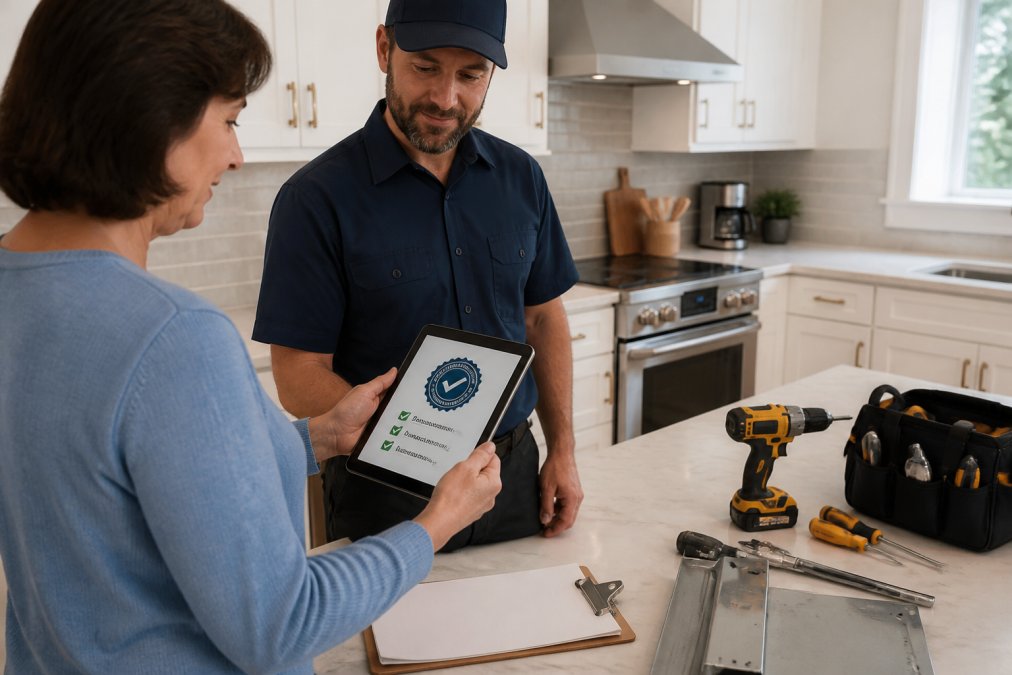
Start with the credential. Every major manufacturer running an authorized installer program issues a technician ID or certification number. Ask for it in writing before the appointment, then confirm it through the manufacturer's dealer or service locator. If the company can't name a program, that's the answer.
Confirm model coverage, not just brand coverage. Ask the installer to state in writing that they're certified for your exact model number. "We're certified for everything" is a red flag, not a convenience.
Check the insurance certificate. Ask for one showing general liability coverage and, where required, workers' compensation, then call the number to confirm the policy is active. A legitimate operation provides this without hesitation.
Understand the labor warranty before work begins. A manufacturer warranty covers the appliance; a labor warranty covers the installation itself, including leaks, electrical faults, and damage during the job. Get the duration in writing, verbal promises don't survive a dispute.
Use this checklist before you book:
- Ask for the technician's manufacturer certification number
- Confirm the certification covers your exact brand and model
- Verify the credential through the manufacturer's dealer locator
- Request a certificate of insurance and verify the dates by phone
- Ask whether the install carries a labor warranty, and for how long
- Get the total price in writing before work starts
- Confirm the installer will register the product with the manufacturer
- Ask who handles a damage claim if something goes wrong
- Check whether the company stocks genuine replacement parts
That last point matters more than people expect: a shop carrying genuine parts and running its own service department can fix a problem without waiting on a third party. At The Appliance Wizard, our factory-trained, certified technicians handle in-home repair, maintenance, and warranty support across most major makes and models, with a full inventory of genuine replacement parts on hand.
Why Verification Pays Off at Claim Time and Sale Time
Two financial events make this checklist worth the ten minutes it takes.
The first is an insurance claim. When a carrier investigates water damage from appliance supply lines, it looks at who performed the work and whether the installation followed manufacturer specifications. A certified installation with a labor warranty gives the insurer a clear responsible party; an unpermitted or uninsured install can give the carrier grounds to deny or reduce the claim, and the homeowner absorbs the difference.
The second is resale. A folder with installation certificates, warranty registrations, and service records signals a well-maintained home, and buyers negotiating on a home with a built-in refrigerator or dual-fuel range respond to proof the equipment was handled correctly. The paperwork from a certified install is worth as much as the install itself.
The U.S. Department of Energy's appliance standards and consumer resources explains how efficiency ratings and installation requirements interact, which helps you ask sharper questions about ventilation and clearances.
| Verification Step | What to Ask For | Red Flag If... |
|---|---|---|
| Certification | Manufacturer credential number | They can't name the program |
| Model coverage | Written confirmation for your model | "We're certified for everything" |
| Insurance | Certificate of insurance | They avoid the request |
| Labor warranty | Written terms and duration | Only a verbal promise |
| Pricing | Itemized written quote | Price changes after the visit |
| Parts | Genuine parts availability | "We'll source it somewhere" |
Frequently Asked Questions
What does it mean to have a factory certified installation?
A factory certified installation means the technician has completed manufacturer-specific training and follows exact installation protocols. This ensures your appliance is set up to manufacturer specifications, which can protect your warranty and optimize performance. Certified installers also carry proper insurance and often provide labor warranties. For example, The Appliance Wizard's factory-trained technicians are certified to install most major brands, giving you confidence that the job is done right the first time.
Does factory certified installation affect my appliance warranty?
Yes, many manufacturers require factory certified installation to validate your warranty. If a non-certified installer makes a mistake, the manufacturer may deny coverage for repairs. Certified installers document their work and follow manufacturer specifications, which helps ensure your warranty remains intact. Always check your appliance warranty coverage requirements before scheduling installation, and ask the installer for proof of certification to avoid voiding your protection.
What are the risks of using a non-certified installer for smart appliances?
Non-certified installers may lack system-specific training, leading to improper connections that can damage smart appliances or void warranties. They might also miss critical setup steps like firmware updates or network configuration, causing connectivity issues. Without manufacturer-backed support, you could face costly repairs. Factory certified installers follow smart appliance setup best practices, ensuring your device works seamlessly and stays protected.
How does factory certification ensure long-term appliance performance?
Factory certification ensures technicians are trained on the latest installation standards and manufacturer specifications. They use standardized procedures and advanced installation techniques that minimize installation defects and maximize equipment longevity. Certified installers also provide post-installation support and can advise on preventative maintenance. This thorough approach reduces service disruption and enhances operational efficiency, saving you money on repairs and energy costs over the appliance's lifespan.