 blog
Buy Refurbished Washers in Illinois: 2026 Guide
Table of Contents
- Why Refurbished Washers Are Worth It in 2026
- Refurbished vs. Reconditioned vs. Scratch and Dent: What's the Difference?
- Where to Find Affordable Scratch and Dent Appliances
- How to Inspect a Used Washer Before You Buy
- Top-Load vs. Front-Load Refurbished Washers: Which Fits Your Home?
- Reconditioned Washing Machine Warranty: What to Expect
- Delivery, Installation, and Repair Services for Your Refurbished Washer
- Maintenance Tips to Extend the Life of Your Refurbished Washer
- Frequently Asked Questions
Last Updated: September 16, 2026
Why Refurbished Washers Are Worth It in 2026
A factory-certified refurbished washer typically costs a fraction of its original retail price while offering the same wash cycles and capacity as a new unit. That gap between discount pricing and full retail price is the single biggest reason budget-conscious homeowners are choosing reconditioned laundry equipment over new machines in 2026.
This guide from The Appliance Wizard covers where to find quality refurbished washers, how to inspect them, what warranty coverage to expect, and how to keep one running for years. We've helped Southern Illinois families outfit their laundry rooms with dependable units.
Here's the reality most buyers miss: a refurbished washer isn't a broken appliance someone patched up. It's a unit that's been cleaned, sanitized, and put through cycle testing before it ever reaches a showroom floor. The savings come from the fact that it's not brand new, not from any hidden defect.
That distinction matters when you're comparing options. A used appliance store selling as-is machines is a different animal from a retailer offering factory-certified, tested models with an extended warranty. Knowing which one you're standing in front of is the whole game.
Below, we'll walk through the differences between refurbished, reconditioned, and scratch and dent appliances, how to inspect a used washer before you commit, and what maintenance keeps a refurbished unit running through its full appliance lifespan.
Refurbished vs. Reconditioned vs. Scratch and Dent: What's the Difference?
Refurbished means the appliance was returned, repaired if needed, cleaned, and tested before resale. Reconditioned typically means it received new parts or a more thorough rebuild. Scratch and dent units are new appliances with cosmetic damage that never worked a day in a home.
The terms get used interchangeably, but they describe different things:
- Refurbished: Returned or traded-in unit, inspected, cleaned and sanitized, and cycle tested. May have minor cosmetic wear.
- Reconditioned: Often involves replacing worn components like hoses, seals, or belts before resale. Functionally closer to new.
- Scratch and dent: Brand-new inventory with dents, scratches, or dings from shipping or showroom handling. Full factory warranty usually applies.
For buyers hunting affordable scratch and dent appliances, that last category is often the best value. You get a new machine with a cosmetic flaw that has zero effect on how it washes clothes. The dent is on the side panel nobody sees.
Reconditioned units sit in the middle. They've had real use, but the parts most likely to fail have already been addressed. A common mistake is assuming "refurbished" and "reconditioned" are marketing synonyms. They're not, and the difference shows up in what's been replaced and what's still original.
Where to Find Affordable Scratch and Dent Appliances
A dedicated used appliance store or a family-owned retailer with a service department is your best starting point.
Here's what to look for when sourcing:
- A physical showroom where you can run the machine and inspect the drum yourself
- In-house repair capability, so warranty claims don't get outsourced to a third party
- Local inventory you can see today rather than waiting weeks on a special order
- Transparent reconditioning records showing what parts were replaced
The Appliance Wizard maintains refurbished and scratch and dent inventory at its Marion (1203 N. Van Buren) and Carbondale (204 E. Walnut St.) showrooms, backed by factory-trained technicians who service what they sell.
Wholesale channels and online marketplaces can offer lower sticker prices, but you lose the ability to inspect the unit and you inherit whatever warranty the seller chooses to honor.
How to Inspect a Used Washer Before You Buy
Inspect a used washer by checking the drum, door seal, hoses, and control panel, then running a full wash cycle before you pay. A ten-minute inspection catches most problems that would otherwise surface in your first week of ownership.
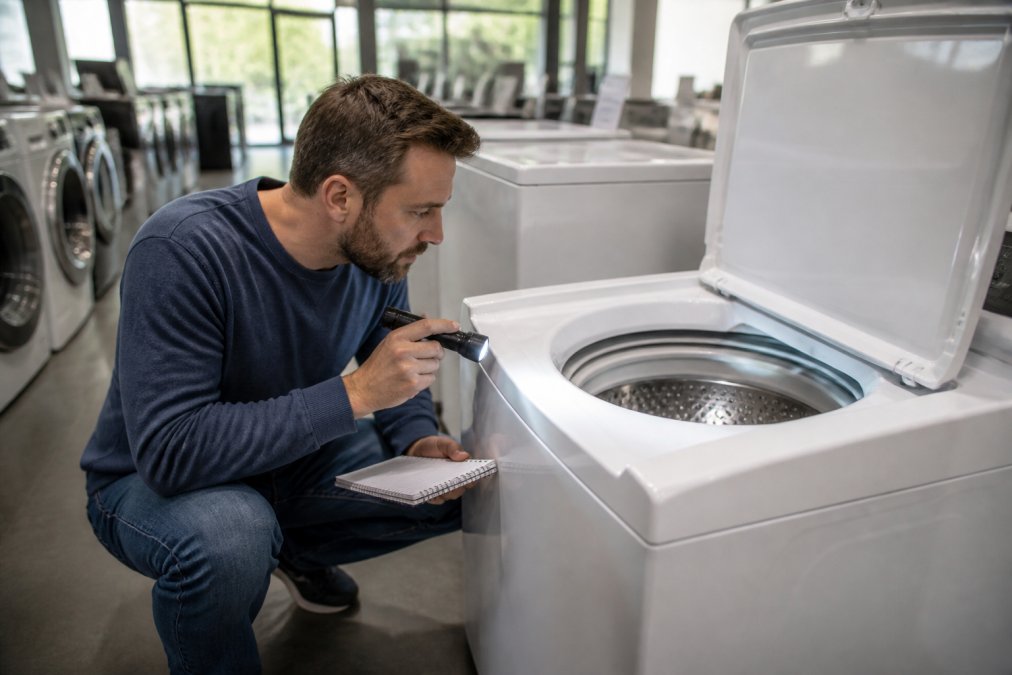
Walk through this checklist in order:
- Drum: Spin it by hand. It should rotate smoothly with no grinding or wobble.
- Door seal (front-load): Look for cracks, mildew, or a loose gasket. A worn seal leaks.
- Hoses: Check for bulges, cracks, or stiff rubber. Replacing hoses is cheap; a burst hose is not.
- Control panel: Press every button. Confirm each wash cycle responds.
- Water inlet: Ask to see the machine fill. Uneven filling points to a clogged screen.
- Drain and spin: Run a full cycle if possible. Listen for unusual noise during the spin phase.
- Leveling feet: Confirm all four are present and adjustable.
The single most useful question to ask is whether the unit passed cycle testing. A seller who runs every machine through a full wash and spin before listing it has already done the inspection you're about to repeat.
For anyone wondering how to inspect a used washer without a technical background, the answer is simpler than it sounds. You're checking for leaks, noise, and smooth operation. If all three pass, you're looking at a sound machine.
Top-Load vs. Front-Load Refurbished Washers: Which Fits Your Home?
Top-load washers cost less to buy and repair, while front-load washers use less water and handle larger loads. The right choice depends on your budget, your space, and how much laundry your household generates each week. But the labels alone don't tell you enough, the real decision comes down to four measurable trade-offs: capacity, water and energy use, cycle time, and repair cost.
Capacity: How Much Laundry Per Load
Most top-load washers sold in the U.S. fall in the 3.5 to 4.5 cubic-foot range, while front-load models commonly run 4.0 to 5.0 cubic feet. That difference sounds small on paper, but it translates to roughly one extra set of queen-size bedding or two extra bath towels per load in a front-loader. For a household running six or more loads a week, that capacity gap is the single biggest reason to consider front-load.
For a single person or a couple running two to three loads a week, a 3.5 cubic-foot top-loader is more than enough, and the smaller drum means less water per cycle anyway.
Water and Energy Use: The Long-Term Math
Front-load washers use less water per load because they tumble clothes through a shallow pool rather than submerging them. A typical front-loader uses roughly 13 to 15 gallons per cycle, while a comparable top-loader uses 20 to 25 gallons. Over a year of regular use, that gap adds up, but only if you're actually running enough loads to notice it.
Here's the angle most buying guides skip: energy efficiency ratings on older refurbished models. A refurbished washer built before current efficiency standards won't match a new high-efficiency unit on water and power use. Factor that into your math. The lower purchase price is real, but so is the slightly higher operating cost over the machine's lifespan. If you're comparing a 2015-era refurbished top-loader against a 2022-era refurbished front-loader, the newer unit will likely carry a better efficiency profile even after reconditioning.
Cycle Time: The Trade-Off Nobody Mentions
Front-load washers typically run longer cycles, often 60 to 90 minutes for a normal load, because they use less water and rely on mechanical tumbling. Top-loaders often finish a normal cycle in 30 to 45 minutes. If you're doing laundry late at night or squeezing loads between other tasks, that time difference matters more than the water savings.
Repair Cost and Complexity
Top-load washers are mechanically simpler. Fewer parts, easier access, and cheaper replacement components mean a typical repair bill runs lower. Front-loaders have more complex suspension systems, door-lock assemblies, and drain pumps, so parts and labor tend to cost more when something fails. For a rental property or a starter home where you want the lowest total cost of ownership, a refurbished top-loader is hard to beat.
A Simple Decision Framework
- Household of 1-2, tight budget, small space: Refurbished top-load.
- Household of 3-4, average laundry volume: Either works, pick based on price and condition.
- Household of 5+, or anyone washing bulky bedding regularly: Refurbished front-load.
- Rental property or short-term hold: Refurbished top-load for lower repair exposure.
- Long-term home, willing to pay more upfront for efficiency: Refurbished front-load.
| Feature | Top-Load Refurbished | Front-Load Refurbished |
|---|---|---|
| Typical capacity | 3.5-4.5 cu. ft. | 4.0-5.0 cu. ft. |
| Water use per cycle | ~20-25 gallons | ~13-15 gallons |
| Typical cycle time | 30-45 minutes | 60-90 minutes |
| Purchase price | Lower | Higher |
| Repair cost | Lower | Higher |
| Best for | Tight budgets, small spaces, rentals | Large families, efficiency, bulky loads |
Reconditioned Washing Machine Warranty: What to Expect
A reconditioned washing machine warranty typically covers parts and labor for a set period, often shorter than a new-unit factory warranty. Always confirm what's covered, who performs the service, and whether the warranty transfers if you move. The difference between a warranty that protects you and one that doesn't comes down to three things: length, scope, and who actually honors it.
Typical Coverage Lengths
There's no industry-wide standard for refurbished appliance warranties, but common patterns exist:
- 30 to 90 days: The minimum most reputable sellers offer. Covers major mechanical failures only.
- 6 months to 1 year: A stronger warranty, usually offered by retailers with in-house service departments.
- 1 to 2 years: Less common on refurbished units, but available as a paid extended warranty from some retailers.
For comparison, a new washer from a major manufacturer typically carries a one-year parts-and-labor warranty, with longer coverage on specific components like the motor or drum. A refurbished unit's warranty will almost always be shorter, that's part of what you're trading for the lower price.
What's Usually Covered, and What Isn't
Most refurbished washer warranties cover:
- Mechanical failures of major components (motor, transmission, drain pump, control board)
- Parts and labor, if the seller services the unit themselves
- Functional defects that appear during normal use
Most refurbished washer warranties exclude:
- Cosmetic damage (scratches, dents, faded panels)
- Damage from improper installation or hookup
- Damage from misuse, overloading, or unauthorized repairs
- Consumable parts like hoses, seals, and filters in some policies
Ask for the warranty terms in writing before you pay. A verbal promise isn't enforceable, and a written policy tells you exactly what you're getting.
Who Honors the Warranty Matters More Than the Length
A 90-day warranty backed by the retailer's own service team is often worth more than a one-year warranty routed through a third-party administrator. Here's why: when the seller's certified technicians handle the repair, turnaround is faster, parts are easier to source, and there's no dispute over who's responsible for the diagnosis.
Ask these questions before buying:
- Does the warranty cover both parts and labor, or parts only?
- Who services the machine, the seller, a manufacturer, or a third-party administrator?
- Is there an extended warranty option available, and what does it cost?
- What voids coverage (improper installation, unauthorized repairs, moving the unit)?
- Does the warranty transfer if you sell the appliance or move?
The Claims Process: What Actually Happens
A warranty is only as good as the process behind it. Here's what a well-run claims process looks like:
- You call the seller with the symptom (won't drain, won't spin, leaking).
- The seller schedules a service visit, ideally within a few business days, not weeks.
- A technician diagnoses the issue and confirms whether it's covered.
- The repair is completed with genuine or OEM-equivalent parts.
- You pay nothing for covered parts and labor.
If any step in that chain gets outsourced, especially the diagnosis or the parts sourcing, the process slows down. That's the practical difference between a warranty on paper and one that actually gets honored.
Consumer Protection Basics
In most states, including Illinois, the Illinois Consumer Fraud and Deceptive Business Practices Act gives buyers recourse if a seller misrepresents what a warranty covers. The federal Magnuson-Moss Warranty Act also sets minimum standards for written warranties on consumer products, including the requirement that warranty terms be available for inspection before purchase. If a seller won't show you the written warranty before you buy, that's a red flag.
The Appliance Wizard provides warranty support through its own service department, so a covered repair doesn't turn into a weeks-long back-and-forth. That's the practical difference between a warranty on paper and one that actually gets honored.
Delivery, Installation, and Repair Services for Your Refurbished Washer
Professional delivery and installation removes the two biggest risks of buying a refurbished washer: damaging it in transit and hooking it up wrong. A proper install also protects your warranty, since improper setup is one of the most common reasons coverage gets denied.
What a complete installation should include:
- Delivery to the room of choice, not just the curb
- Hose and connection check to prevent leaks at the water inlet
- Leveling so the machine doesn't walk during the spin cycle
- A test run to confirm fill, drain, and spin all work
- Old unit haul-away, if you need the space cleared
For ongoing needs, in-house appliance repair keeps everything under one roof. When the same team that sold and installed your washer also services it, troubleshooting is faster and parts are easier to source. The Appliance Wizard stocks genuine replacement parts, which matters for DIYers who'd rather handle a small fix themselves.
Maintenance Tips to Extend the Life of Your Refurbished Washer
Refurbished washers last as long as new ones when they're maintained properly. The habits below add years to a machine's service life and cost almost nothing to follow.
- Leave the door or lid open between loads to let the drum dry and prevent mildew.
- Clean the door seal monthly on front-load models with a damp cloth.
- Use the right amount of detergent. Too much leaves residue that clogs lines and dulls wash cycles.
- Run a hot water cycle occasionally to clear buildup inside the drum.
- Check hoses twice a year for cracks or stiffness, and replace them at the first sign of wear.
- Don't overload. Excess weight strains the drum bearing and shortens the machine's life.
- Level the unit if it starts vibrating, and tighten the feet as needed.
For appliance troubleshooting, start with the simple stuff. A washer that won't drain is often a clogged filter, not a dead pump. A machine that shakes is usually unlevel, not broken. Ruling out the easy fixes first saves a service call.
If a problem persists, professional repair is the safer route than a DIY teardown that voids your warranty. The Appliance Wizard's certified technicians diagnose and fix most major makes and models, and the team is happy to troubleshoot over the phone before you commit to a visit.
Buying a refurbished washer comes down to doing the homework: knowing what you're buying, inspecting it properly, and choosing a seller who stands behind the unit after the sale. The savings are real, but only when the machine and the warranty hold up.
The Appliance Wizard makes that easier with in-house reconditioning, factory-trained technicians, transparent warranty support, and flexible financing, all from two Southern Illinois showrooms. Browse current inventory or schedule service at www.theappliancewizard.com and find a dependable refurbished washer that fits your home and your budget.
Frequently Asked Questions
Is a refurbished washer worth it?
A refurbished washer can be a smart buy if it has been properly tested and comes with a warranty. Refurbished units typically cost less than new models and can last for years when maintained well. Look for a washer that has undergone cycle testing, been cleaned and sanitized, and includes a written warranty. Buying from a local appliance store that offers in-house repair service adds another layer of protection for your purchase.
What should I check before buying a used washing machine?
Inspect the drum for rust or cracks, run a short wash cycle to check for leaks and unusual noises, and verify that all connections (hot, cold, drain) are intact. Check the door seal on front-load models for mold or tears. Ask whether the unit was cycle-tested and cleaned. Confirm the warranty terms and whether delivery and installation are included. A quick inspection can save you from buying a washer that needs expensive repairs.
Do refurbished appliances come with a warranty?
Most reputable sellers offer a warranty on reconditioned washing machines, though coverage varies. Some provide a 30-day parts-and-labor guarantee, while others offer extended warranty options for up to a year or more. Always ask for the warranty terms in writing before purchase. A local appliance store with factory-trained technicians is more likely to honor warranty claims quickly because they handle repairs in-house rather than outsourcing them.
How much does a refurbished washing machine cost?
Pricing for refurbished washers depends on the brand, model, age, capacity, and condition. Scratch and dent units typically cost less than reconditioned ones because they may have cosmetic flaws but function perfectly. Front-load and energy-efficient models generally cost more than basic top-load units. Contact a local appliance showroom for current pricing and available inventory, since prices change based on what is in stock.