 comparison
Convection vs. Regular Ovens: A Buyer's Guide
Table of Contents
- What Is a Convection Oven and How Does It Work?
- Convection vs. Regular Ovens: Key Differences
- When to Use Convection vs. Regular Bake
- How to Adjust Baking Time for Convection Ovens
- Convection Oven Conversion Chart and Recipe Adjustments
- Best Foods for Convection Ovens
- Pros and Cons of Convection Ovens
- Multi-Rack Baking and Energy Efficiency
- Making Your Choice: Which Oven Is Right for You?
- Frequently Asked Questions
Last Updated: September 29, 2026
What Is a Convection Oven and How Does It Work?
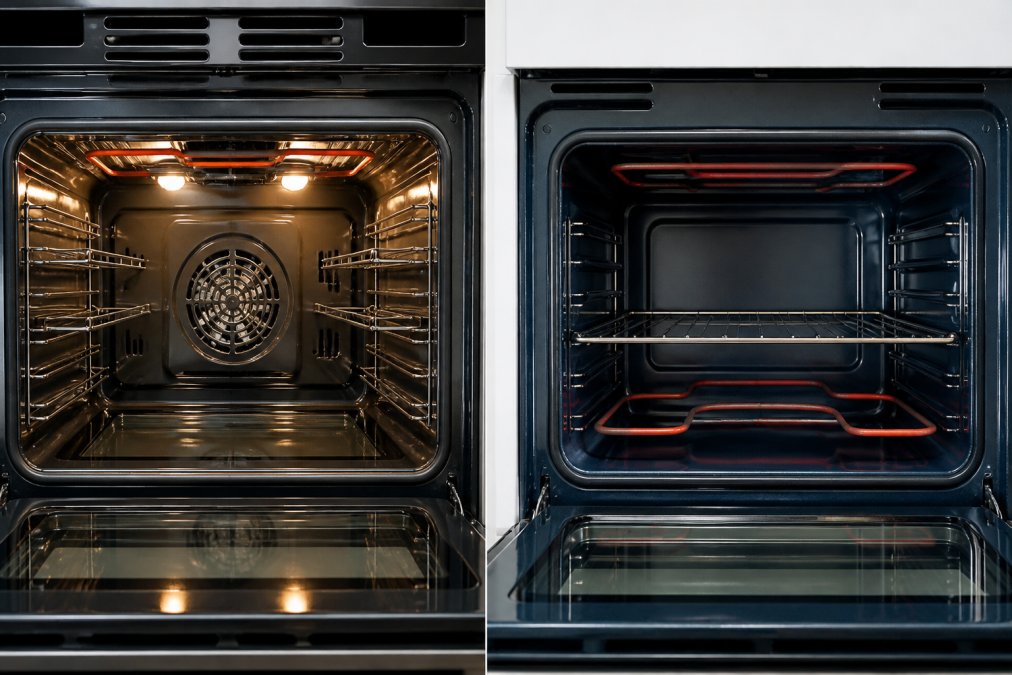
A convection oven is an appliance that uses a fan and exhaust system to circulate hot air around food, creating even heat distribution throughout the cooking chamber. When comparing convection vs regular ovens, the key difference is that convection actively moves air to accelerate cooking and promote consistent browning, while conventional ovens rely on heating elements alone.
The mechanics are straightforward. A heating element warms the air inside the oven cavity. A fan then circulates that heated air continuously, and an exhaust system removes moisture and stale air. This fan-forced circulation ensures that every rack position receives similar thermal energy, eliminating hot spots and cold zones that plague traditional ovens.
The result is faster cooking, more uniform browning, and crisping that's difficult to achieve with conventional bake alone. For homeowners planning a kitchen remodel, understanding this difference is essential to choosing the right oven for your cooking style and needs.
Convection vs. Regular Ovens: Key Differences
Understanding convection vs regular ovens comes down to how heat moves inside the cooking chamber and what that means for your results. These two technologies produce measurably different outcomes.
Heat Distribution and Air Circulation
In a conventional oven, heat rises from the bottom heating element and settles at the top. This creates uneven temperatures, the top rack may run 25-50 degrees hotter than the bottom. Food closer to heating elements browns faster, while distant items cook slower. You end up rotating pans halfway through baking to compensate.
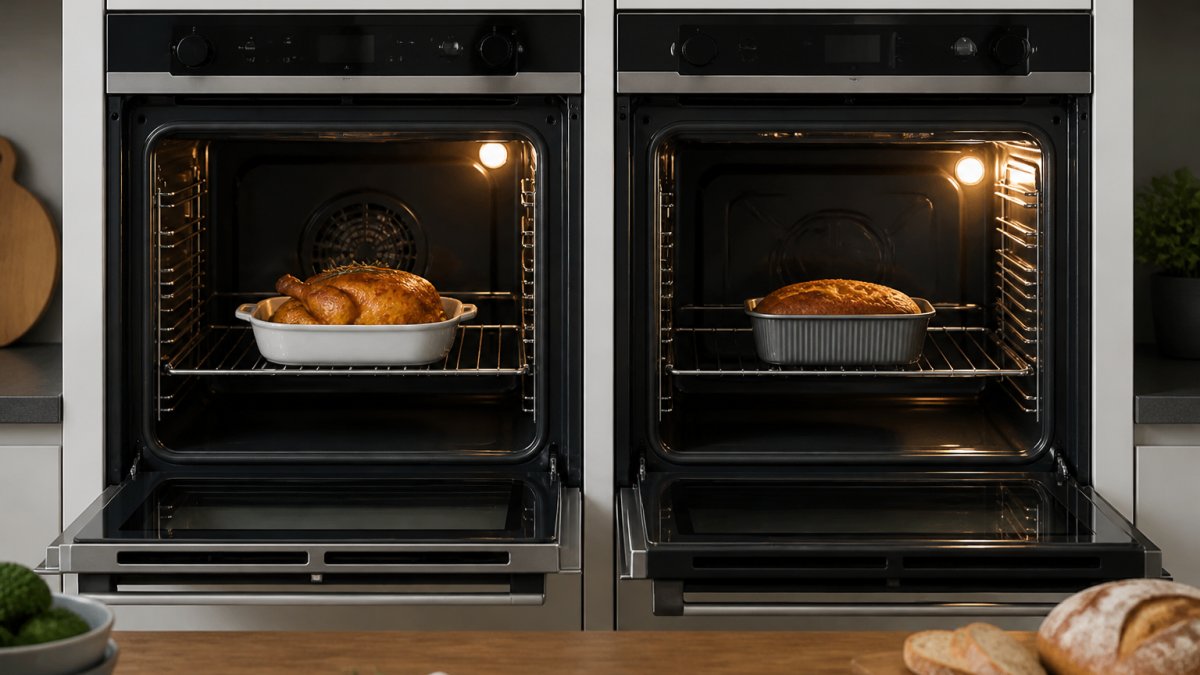
Convection eliminates this problem. The fan distributes heat evenly across all racks simultaneously. Air circulates at consistent temperatures, so a cookie sheet on the top rack bakes identically to one on the bottom. This uniform thermal circulation is why convection is preferred for multi-rack baking and commercial kitchens.
Cooking Time and Temperature
Convection cooks faster than conventional bake. The moving air transfers heat to food more efficiently, reducing cooking time by roughly 25 percent on average. A roast that takes 45 minutes in a conventional oven might finish in 30-35 minutes in convection mode.
Temperature adjustment is necessary when converting recipes. Most guides recommend reducing the oven temperature by 25 degrees Fahrenheit when switching from conventional to convection. This prevents over-browning or drying out the exterior before the interior cooks through.
Browning, Crisping, and Texture Results
Convection excels at browning and crisping. The moving air removes moisture from food surfaces, promoting caramelization and creating crispy exteriors on roasted vegetables, poultry, and baked goods. Conventional ovens can achieve browning, but it requires longer cooking times and closer monitoring.
For delicate pastries and cakes, convection's drying effect can be a drawback. Unprotected items may brown too quickly on the outside while remaining underdone inside. Covering dishes with foil or using a lower temperature mitigates this issue.
When to Use Convection vs. Regular Bake
Knowing when to choose each mode is the key to consistent results. The decision depends on what you're cooking and your desired outcome.
Best Uses for Convection Cooking
Convection shines with roasted foods. Chicken, vegetables, and root crops all benefit from the rapid browning and even heat distribution. The moving air renders poultry skin crispy while keeping meat juicy, something conventional ovens struggle to achieve consistently.
Baked goods that benefit from convection include cookies, biscuits, and pastries that need crispness. Convection also works well for reheating leftovers and frozen foods, since the moving air cooks them faster without drying them out as much as conventional heat would.
Multi-rack baking is convection's strongest advantage. If you're baking six sheet pans of cookies at once, convection ensures even browning across all racks without rotating halfway through.
When Regular Bake Is the Better Choice
Use regular bake for items that require gentle, even cooking without surface drying. Custards, cheesecakes, and delicate cakes often turn out better in conventional mode. The stationary heat prevents the exterior from setting before the interior reaches the correct temperature.
Bread baking is traditionally done in conventional ovens, though some bakers prefer convection for its crust-crisping effect. If your recipe was developed for conventional bake, stick with that mode unless you're willing to adjust temperatures and timing.
Foods with exposed toppings, like casseroles with cheese or breadcrumb crusts, may brown too quickly in convection. Conventional bake gives you more control over browning speed.
How to Adjust Baking Time for Convection Ovens
Converting a conventional recipe to convection requires two adjustments: temperature and time.
Start by reducing the oven temperature by 25 degrees Fahrenheit. A recipe calling for 375°F in conventional mode becomes 350°F in convection. This prevents over-browning.
Next, reduce cooking time by 25 percent. A dish that bakes for 40 minutes conventionally should be done in about 30 minutes with convection. Check for doneness earlier than the recipe suggests, since cooking times vary by oven model and food thickness.
Use visual cues to guide you. Look for browning, test with a thermometer, or use the toothpick test for baked goods. Every oven behaves slightly differently, so the first time you convert a recipe, check progress at the adjusted time and adjust as needed.
Convection Oven Conversion Chart and Recipe Adjustments
Use this conversion chart when adapting recipes from conventional to convection cooking.
| Conventional Temperature | Convection Temperature | Time Reduction | Best For |
|---|---|---|---|
| 325°F | 300°F | 25% less | Roasted meats, poultry |
| 350°F | 325°F | 25% less | Cakes, cookies, pastries |
| 375°F | 350°F | 25% less | Baked vegetables, casseroles |
| 400°F | 375°F | 25% less | Roasted root vegetables, bread |
| 425°F | 400°F | 25% less | Quick-roasting foods, biscuits |
| 450°F | 425°F | 25% less | High-heat roasting, crisping |
Start checking food at 75 percent of the original cooking time. If it's not done, add time in 5-minute increments until it reaches the desired doneness.
Understanding Why the 25-Degree Rule Isn't Universal
The standard 25-degree reduction works for most recipes, but oven design matters. Convection ovens with the heating element positioned behind the fan (true convection) distribute heat more evenly than models where the element is separate. If your oven manual specifies "true convection" or "European convection," you may find the 25-degree reduction is conservative, some recipes work equally well at a 15-degree reduction. Conversely, ovens with less sophisticated fan designs may require a 30-degree reduction to prevent over-browning.
Check your oven's manual for manufacturer guidance. Many brands provide their own conversion recommendations based on their specific heating and circulation design.
Recipe-Specific Conversion Guidance
Roasted meats and poultry: Reduce temperature by 25°F and time by 25 percent. Use a meat thermometer to verify doneness (165°F for poultry, 145°F for pork, 160°F for ground meats). The moving air promotes browning, so the exterior will look done before the interior reaches safe temperature if you rely on color alone.
Baked goods (cakes, brownies, quick breads): Reduce temperature by 25°F but check at 20 percent less time rather than 25 percent. These items are sensitive to over-browning. If the top is golden but a toothpick inserted in the center comes out wet, lower the temperature another 10°F and continue baking. Covering the top loosely with foil in the final 5-10 minutes prevents excessive browning while the interior finishes.
Cookies: Reduce temperature by 25°F and time by 20-25 percent. Convection's drying effect is actually an advantage here, cookies crisp up faster. Watch for edges to turn golden; they'll continue cooking slightly after removal due to residual heat.
Custards, cheesecakes, and cream pies: Do not use convection for these. The moving air disrupts the gentle, even cooking these dishes require. Stick with conventional bake, even if it takes longer.
Bread dough (final bake only): Some bakers reduce temperature by 15-20°F (not the full 25°F) to allow the interior to rise without the crust setting too quickly. The first rise should always be in a conventional oven or proofing box. If you use convection for the final bake, reduce time by 15-20 percent and watch for crust color rather than relying on the original recipe's timing.
Common Conversion Mistakes to Avoid
Mistake 1: Reducing both temperature and time too aggressively. If you drop the temperature 25°F and cut time by 25 percent, you risk undercooking. Start with the temperature reduction first, then monitor time. Adjust one variable at a time.
Mistake 2: Ignoring oven preheating. Convection ovens need adequate preheating (usually 10-15 minutes) to stabilize the fan and reach target temperature. Placing food in a not-fully-preheated convection oven leads to uneven cooking.
Mistake 3: Overcrowding racks. Even though convection distributes heat evenly, air still needs to circulate around food. If you pack the oven too densely, the moving air can't reach all surfaces. Leave at least 2 inches of space between pans and the oven walls.
Mistake 4: Using the same conversion for all foods. A 25-degree reduction works for roasted vegetables and meats but may be too aggressive for delicate pastries. Treat each food category according to the guidance above.
Best Foods for Convection Ovens
Certain foods are natural fits for convection cooking, while others are better left to conventional bake.
Root vegetables like potatoes, carrots, and beets caramelize beautifully in convection. The moving air removes surface moisture, promoting browning and concentrating flavor. Roasted Brussels sprouts, broccoli, and asparagus also benefit from convection's crisping effect.
Poultry and game birds are convection favorites. Chicken thighs and whole turkeys develop golden, crispy skin while staying moist inside. The even heat distribution ensures wings and thighs cook at the same rate as the breast.
Cookies and biscuits bake evenly in convection, with consistent browning across all racks. Frozen foods reheat faster and more evenly in convection mode, making it ideal for warming up leftovers without drying them out.
Avoid convection for cheesecakes, custard-based dishes, and delicate pastries that rely on gentle, stationary heat. Bread dough rises better in conventional mode, though some artisan bakers use convection for the final bake to crisp the crust.
Pros and Cons of Convection Ovens
Understanding the strengths and limitations of convection cooking helps you decide if it's the right choice for your household.
Advantages of Convection Cooking
Faster cooking: Convection reduces cooking time by roughly 25 percent, which saves energy and gets food on the table quicker. For busy households, this efficiency matters.
Even browning and crisping: The circulating air promotes consistent browning across all racks without rotation. This is especially valuable for multi-rack baking and roasting.
Better for large batches: If you're cooking for a crowd or preparing multiple dishes at once, convection's even heat distribution means everything finishes at the same time.
Consistent results: Once you master temperature and time adjustments, convection delivers predictable outcomes. Professional kitchens rely on this consistency.
Disadvantages and Limitations
Steeper learning curve: Converting recipes and adjusting temperatures takes practice. Beginners often over-brown food or dry it out on their first attempts.
Not ideal for all foods: Delicate baked goods, custards, and bread dough perform better in conventional mode. Convection isn't a one-size-fits-all solution.
Higher upfront cost: Convection ovens are more expensive than conventional models due to the added fan and exhaust system. Maintenance costs may also be higher if the fan requires repair.
Noise: The fan creates audible sound during cooking, which some people find distracting in an open kitchen layout.
Multi-Rack Baking and Energy Efficiency
Multi-Rack Baking: The Convection Advantage
One of convection's biggest practical advantages is its ability to handle multiple racks of food simultaneously without quality loss. In a conventional oven, baking six sheet pans of cookies requires rotating pans halfway through to ensure even browning, the top rack runs hotter, so cookies there brown faster than those on the bottom. Convection eliminates this step entirely.
The even thermal circulation means you can fill all racks and expect consistent results across every level. This is especially valuable during holiday baking or when preparing for large gatherings. You save time and effort while achieving uniform quality.
How to maximize multi-rack convection baking:
- Leave adequate spacing. Position racks so there's at least 2 inches between the top of your pans and the oven ceiling, and 2 inches between the bottom of pans and the rack below. This allows the circulating air to flow freely around all sides of the food.
- Stagger pans on alternating racks. If baking on three racks, place pans on racks 1 and 3, leaving rack 2 empty. This prevents one pan from blocking airflow to another.
- Avoid blocking the fan or exhaust. Most convection ovens have a fan intake and exhaust vent (usually at the back or side). Don't position tall pans directly in front of these openings.
- Use the same pan type on all racks. Dark metal pans conduct heat differently than light-colored or glass pans. For consistent browning across racks, use identical cookware.
With these adjustments, you can bake 4-6 sheet pans of cookies, biscuits, or roasted vegetables in a single cycle without rotating, cutting your baking time in half compared to conventional ovens.
Energy Efficiency: Real Costs and Savings
Convection cooks faster, which reduces overall cooking time and energy consumption, but the fan itself uses electricity. Understanding the actual energy trade-off helps you evaluate whether convection is worth the investment.
How much electricity does a convection fan use?
A typical convection oven fan draws 50-150 watts depending on motor size and speed. For comparison, a conventional oven's heating elements draw 2,000-5,000 watts. The fan's power draw is significant but small relative to the heating elements.
Calculating net energy savings:
Assuming a convection oven reduces cooking time by 25 percent and your local electricity rate is $0.14 per kilowatt-hour (the national average):
- A conventional oven baking for 40 minutes at 3,500 watts uses approximately 2.33 kilowatt-hours (kWh), costing roughly $0.33.
- The same dish in convection at 3,500 watts for 30 minutes uses 1.75 kWh, costing $0.24.
- The convection fan running for 30 minutes at 100 watts uses 0.05 kWh, costing $0.007.
- Net savings per bake: $0.33 − ($0.24 + $0.007) = $0.08 per bake.
For a household that bakes or roasts twice weekly (100 times per year), the annual electricity savings would be roughly $8. Over a 15-year oven lifespan, that's $120 in energy savings.
When energy savings become meaningful:
Energy savings are modest for occasional bakers but compound for high-volume cooking. Commercial kitchens and catering operations that use convection ovens for 8+ hours daily see measurable utility bill reductions. Home bakers benefit more from the time savings (getting dinner on the table 10 minutes faster) than from electricity cost reduction.
Other efficiency factors:
- Preheating time: Convection ovens often preheat faster because the fan distributes heat quickly. This saves 2-3 minutes per cooking session.
- Residual heat: Convection ovens cool down faster after cooking because the fan exhausts hot air. This is an advantage in summer (less kitchen heat buildup) but a disadvantage in winter (more heating needed to maintain home temperature).
- Oven insulation: Modern convection ovens often have better insulation than older conventional models, reducing heat loss regardless of cooking method.
Making Your Choice: Which Oven Is Right for You?
Your cooking habits and kitchen priorities determine whether convection or regular bake is the better fit.
Choose convection if you roast vegetables and poultry regularly, bake multiple batches at once, or value speed and consistency. Convection is also ideal if your kitchen remodel includes a new oven and you want modern cooking flexibility.
Choose regular bake if you primarily bake cakes, pastries, and bread, or if you prefer cooking one dish at a time. Conventional ovens are also simpler to use and less expensive upfront.
Many homeowners benefit from an oven that offers both modes. Dual-function ranges let you choose the right method for each dish, giving you maximum flexibility without compromise.
When planning a kitchen remodel, the team at The Appliance Wizard can help you evaluate your cooking style and recommend an oven that matches your needs. Our expert staff understands the practical differences between convection and regular bake, and we carry a wide selection of ranges and wall ovens from top manufacturers.
Frequently Asked Questions
Is 350 degrees in a convection oven the same as 350 in a regular oven?
No. A convection oven circulates hot air with a fan, creating faster and more even heat transfer. The same temperature setting will cook food faster and hotter than a regular oven. Most recipes require lowering the temperature by 25°F or reducing cooking time by 15-25% when using convection. Always check food earlier than the recipe suggests to avoid overcooking.
When should you not use a convection oven?
Avoid convection for foods that rise unpredictably, such as soufflés, custards, and some cakes, because the air circulation can disrupt rising. Delicate items like angel food cakes and cream pies also perform better in regular bake mode. Bread dough and foods requiring moisture retention may brown too quickly. When in doubt, use the regular bake setting or turn off the convection fan if your oven allows it.
Do you need special pans for convection ovens?
Standard baking pans work in convection ovens, but material matters. Use metal pans rather than glass, which can conduct heat too aggressively and cause over-browning. Avoid tall-sided pans that block airflow. Flat, rimmed baking sheets with low sides allow hot air to circulate evenly around food. Dark or nonstick pans may brown food faster, so monitor cooking closely or reduce temperature slightly.
What are the main advantages of a convection oven?
Convection ovens cook 15-25% faster than regular ovens, save energy by requiring lower temperatures, and produce more even browning and crisping. They excel at roasting vegetables and meats, baking cookies with consistent texture, and preparing multiple trays simultaneously. The even heat distribution reduces hot spots, so food cooks uniformly regardless of rack position. This efficiency makes them ideal for busy households and frequent bakers.