 how-to
DIY Appliance Repair Safety Tips: A 2026 Guide
Table of Contents
- Why Appliance Repair Safety Matters More Than Ever
- Electrical Safety for Home Repairs: The Basics You Cannot Skip
- Essential Tools for Home Appliance Repair
- Identifying Electrical Hazards Before You Start
- Gas Appliances, Refrigerants, and Other High-Risk Repairs
- When to Call a Professional Appliance Repair Technician
- Post-Repair Safety Testing and Reassembly
- Child and Pet Safety During Repairs
- Safe Disposal of Hazardous Components
- Conclusion
- Frequently Asked Questions
Last Updated: September 27, 2026
Why Appliance Repair Safety Matters More Than Ever
DIY appliance repair safety tips start with one hard truth: the appliance that looks harmless on your kitchen floor can hold a lethal charge even after you pull the plug. Skipped safety steps can lead to avoidable mistakes.
Modern appliances pack more electronics than ever. Touch panels, inverter boards, and smart modules all hold stored power. That changes the rules for anyone working at home.
This guide covers the safety steps that matter most. You'll learn how to kill the power, test for voltage, pick the right gear, and spot the repairs you should never touch yourself.
Electrical Safety for Home Repairs: The Basics You Cannot Skip
Electrical safety for home repairs comes down to three habits: kill the power, prove it's dead, and keep one hand free. Skip any of them and you're gambling with a shock that can stop your heart.
Start at the breaker box. Flip the correct breaker and label it so nobody flips it back while you work.
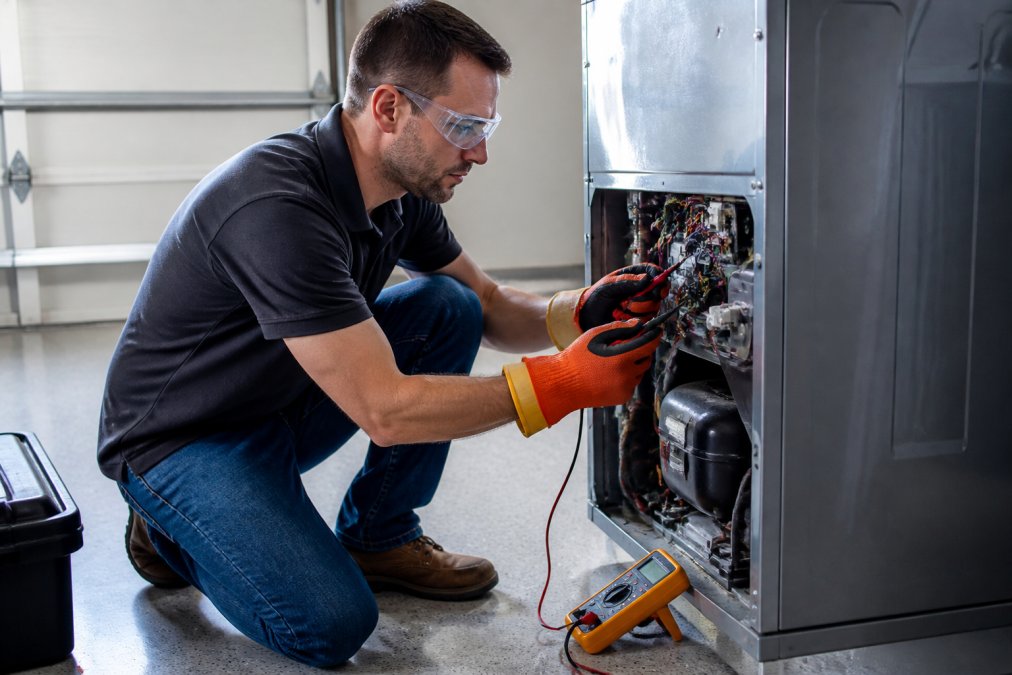
Then test. A non-contact voltage tester tells you if a wire is live. A multimeter gives you a real number. Never trust a switch alone.
Shutting Off Power at the Breaker
Find the breaker that feeds the appliance, not just the one labeled for the room. Some kitchens split power across two breakers.
- Turn the breaker fully to OFF
- Tape it off so no one restores power
- Tell everyone in the house what you're doing
- Confirm with a voltage tester at the appliance
If the panel is old, unlabeled, or warm to the touch, stop. Call a licensed electrician.
Testing for Voltage and Capacitor Discharge
A capacitor is a component that stores electrical energy, and it can hold a dangerous charge long after the power is off. Microwaves are the classic example.
Discharge a capacitor only if you know the safe method for that model. Otherwise, leave it alone.
For a continuity test, a multimeter sends a small current through a circuit to check for breaks. It's a safe test on a dead circuit, but never on a live one.
Essential Tools for Home Appliance Repair
The essential tools for home appliance repair are fewer than you'd think, but each one earns its place. Buy quality once and these tools last for years.
| Tool | What It Does | Why It Matters |
|---|---|---|
| Voltage tester | Checks for live current | Confirms power is off |
| Multimeter | Reads voltage, continuity | Diagnoses circuits safely |
| Insulated screwdrivers | Turn fasteners | Protects against shock |
| Nut drivers | Grip hex screws | Prevents stripped heads |
| Pliers set | Grip and cut wire | Handles wiring harness work |
Add a flashlight, a small parts tray, and your appliance manual. The manual lists technical specifications and wiring details you'll need.
Personal Protective Equipment
Protective gloves made for electrical work block current from reaching your skin. Thin latex gloves do not.
Safety goggles protect against sharp edges, springs, and debris that fly when panels pop loose.
- Insulated gloves rated for electrical work
- Safety goggles or a face shield
- Closed-toe shoes with rubber soles
- No loose sleeves, jewelry, or hanging drawstrings
Identifying Electrical Hazards Before You Start
A hazard walk-through is a diagnostic pass, not a glance. Before you open a panel, you are looking for evidence of heat, arcing, moisture, and mechanical damage, and each one points to a different failure mode. Knowing what a symptom means tells you whether to keep going or stop.
Reading the Symptoms
Scorch marks, melted plastic, or a fishy burning smell point to sustained overheating, usually at a loose connection. A terminal screw that was never torqued to spec creates resistance, resistance creates heat, and heat eventually carbonizes the insulation. That carbon is conductive, so the fault gets worse over time. Do not clean it off and reuse the part; the damaged section has to be replaced.
A warm outlet, plug, or cord end is the same story at lower intensity. Warm is not normal. If the plug body is hot to the touch after normal use, the receptacle or the cord end is failing.
Buzzing or crackling is arcing. Arcing means current is jumping a gap it should not be jumping, and it can ignite nearby dust or insulation. Cut power at the breaker before you investigate further.
Repeated breaker trips are the circuit telling you it is overloaded or that a component is drawing more current than it should. A breaker that trips once and resets cleanly is a data point. A breaker that trips every time the appliance runs is a fault.
A tripping GFCI on a kitchen or laundry circuit is different from a tripping breaker. A GFCI senses current leaking to ground, which often means moisture or a damaged heating element, not an overload.
Inspecting the Cord and Plug
Run your hand along the entire cord, not just the visible section. Look for:
- Cracks or brittleness in the outer jacket, especially where the cord enters the strain relief
- Flattened or pinched sections from being run under a leg or through a door
- A plug with bent prongs, a cracked face, or discolored metal
- A ground pin that has been cut off or bent back
A cord with a damaged jacket can arc against a metal cabinet. Replace the cord; do not tape it.
Checking the Breaker Panel
Open the panel only if you are comfortable doing so. Look for a breaker that is warm, a breaker that will not reset, or a double-tapped breaker (two wires under one terminal), which is a common and dangerous shortcut. If the panel is old, unlabeled, or shows rust or moisture, stop and call a licensed electrician.
Moisture and Water
Water plus electricity is the fastest path to a serious shock, and it is also the most common cause of a GFCI trip. Look for:
- Standing water under a refrigerator, washer, or dishwasher
- A supply line with a slow drip onto a terminal block
- Condensation on a cold water line running near a heating element
Dry the area and find the source before you restore power. A wet floor is not a reason to work faster; it is a reason to stop.
Gas Odor Near an Electric Appliance
If you smell gas near a gas appliance, treat it as a leak until proven otherwise. Do not flip a light switch, do not unplug anything, and do not use a phone inside the house. Leave, then call your gas utility from outside.
The Stop List
If you find any of the following, do not proceed:
- Burn marks or melted plastic
- Buzzing or crackling sounds
- A warm outlet or plug
- Repeated breaker trips
- A gas leak smell near a gas appliance
- A cord with exposed conductors
Any one of these is a professional call, not a DIY project.
Gas Appliances, Refrigerants, and Other High-Risk Repairs
Gas and refrigerant work sits in a different category because the failure modes are not survivable with caution alone. Understanding why each one is dangerous is what separates a safe DIYer from someone who guesses.
Gas Appliances: The Combustion Side
A gas appliance has two separate systems: the gas supply and the combustion air path. A gas leak can fill a room with explosive vapor, and the ignition source can be a light switch, a thermostat click, or static. If you smell gas, leave the house and call your gas utility from outside.
Carbon monoxide is the silent danger (the CDC). It forms when a gas appliance burns with insufficient oxygen, which happens when the burner is dirty, the flue is blocked, or the combustion air intake is obstructed. CO has no smell and no color, and it displaces oxygen in the blood. A CO alarm is not optional in a home with gas appliances; it is the only warning you get.
A thermal fuse on a gas appliance is a one-time safety device. It opens the circuit permanently when a preset temperature is exceeded, which usually means the vent is blocked or the blower has failed. Never bypass a thermal fuse or a safety switch. If it opened, something upstream caused it, and that cause is still there.
Proper ventilation matters during any test. Run the appliance only with the vent connected and the room air path clear.
Refrigerants: Pressure and Displacement
Refrigerant is under pressure and can cause frostbite on contact with skin or eyes. In a closed space, a large release can displace oxygen and cause asphyxiation. Handling it requires a license and recovery equipment, and venting it to the atmosphere is illegal under federal law.
Never open a sealed refrigerant system. The sealed system includes the compressor, condenser, evaporator, and the lines connecting them. A puncture or a loose fitting releases the charge, and recharging requires a vacuum pump, a manifold gauge set, and a refrigerant scale.
The Decision Framework
Use this to decide whether a repair is yours to make:
- Safe to try: belts, gaskets, filters, door seals, drain hoses, igniters on a gas range (with the gas shut off at the valve)
- Call a pro: gas lines, compressors, control boards, sealed systems, anything requiring a license
- Stop immediately: sparks, burning smells, repeated breaker trips, a CO alarm, or a gas odor
A gasket seal or thermal fuse swap is a solid DIY job on an electric appliance. A compressor replacement is not, on any appliance.
Smart Appliance and Control Board Risks
Modern appliances add a layer: sensitive electronics. A control board can be damaged by static electricity, so touch a grounded metal surface before handling one. Disconnect the appliance from power and, if it is a smart appliance, from the network before you work. A board that stores user data or pairing credentials should be treated as a data-bearing component, not just a part.
When to Call a Professional Appliance Repair Technician
You should call a professional appliance repair technician when the repair involves gas, sealed refrigerant, or a wiring harness you can't trace. Those jobs need tools, training, and licensing you likely don't have.
Use this rule of thumb:
- Safe to try: belts, gaskets, filters, door seals, drain hoses
- Call a pro: gas lines, compressors, control boards, sealed systems
- Stop immediately: sparks, burning smells, or repeated breaker trips
A gasket seal or thermal fuse swap is a solid DIY job. A compressor replacement is not.
Warranty and Safety Red Flags
A DIY repair can void your warranty if you damage a sealed part or break a tamper seal. Check your paperwork before you start.
Red flags that mean call a pro:
- The appliance is still under warranty
- You can't find a replacement part
- The repair needs a licensed trade
- You feel unsure at any point
Post-Repair Safety Testing and Reassembly
Post-repair safety testing is the step most DIYers skip, and it's the one that catches problems before they hurt someone. Never restore power and walk away.
Reassemble in reverse order. Reconnect the wiring harness exactly as your photo showed. Check that every gasket seal sits flat.
Then test in stages:
- Confirm all covers and screws are back
- Restore power at the breaker
- Listen and smell for anything odd
- Run the appliance through one full cycle
- Check for leaks, heat, or vibration
Run a continuity test on any circuit you touched before you close it up. It confirms your work is sound.
If anything sparks, smells hot, or trips the breaker, cut power and call a pro.
Child and Pet Safety During Repairs
Kids and pets turn a repair zone into a hazard fast. Set the boundary before you open a single panel.
- Keep children and pets out of the room
- Never leave tools or small parts on the floor
- Store screws and sharp edges out of reach
- Block the area with a gate or closed door
- Unplug the appliance whenever you step away
Small parts look like toys. Loose wire and open panels invite curious hands.
If you can't fully secure the space, do the repair when the house is quiet, or wait for help.
Safe Disposal of Hazardous Components
Some old parts are hazardous waste, not trash. Toss them in the bin and you create a real problem.
- Capacitors can hold a charge and should be discharged or handled by a pro
- Refrigerant must be recovered by a licensed technician
- Old thermal fuses and control boards may contain metals that need special handling
- Batteries from smart appliances should go to a recycling center
Check with your county waste office for drop-off rules. Many areas hold household hazardous waste days.
Keep old parts away from kids and pets until they're gone.
Conclusion
DIY appliance repair saves money when you respect the risks. The moment a repair touches gas, sealed refrigerant, or a circuit you can't isolate, the math changes.
At The Appliance Wizard, our factory-trained, certified technicians provide timely, professional in-home repair, maintenance, and warranty support across most major appliance makes and models. We also maintain a comprehensive inventory of genuine replacement parts. We offer flexible financing solutions tailored to your financial needs. We carry an extensive lineup of refrigerators, ranges, wall ovens, cooktops, dishwashers, microwaves, washers, and dryers.
Explore our current inventory, browse package deals, or schedule service online anytime at www.theappliancewizard.com.
Frequently Asked Questions
What is the 50/50 rule for appliance repair?
The 50/50 rule is a common guideline: if the cost of a repair is more than half the price of a new appliance, or if the appliance is more than halfway through its expected lifespan, replacement often makes more financial sense. For example, spending $400 to fix a 12-year-old washer that cost $800 new may not be worth it. Always factor in the age, repair cost, and energy efficiency of a new model before deciding.
What basic tools are needed for safe appliance troubleshooting?
At minimum, you need a voltage tester, a multimeter for continuity tests, insulated screwdrivers, pliers, and a nut driver set. Safety gear like protective gloves and safety goggles is non-negotiable. For gas appliances, a gas leak detector is essential. Keep the appliance manual nearby for wiring diagrams and technical specifications. Never substitute regular tools for insulated ones when working near live circuits.
How do I safely disconnect power before starting a repair?
First, unplug the appliance if the cord is accessible. If not, go to your home's circuit breaker panel and switch off the breaker that controls that appliance. Use a voltage tester on the appliance's wiring to confirm power is off. For appliances with capacitors, like microwaves, discharge them safely before touching any components. Lock the breaker box if possible to prevent someone from accidentally restoring power while you work.
Are there specific safety standards for home appliance maintenance?
Yes, the National Electrical Code (NEC) sets standards for electrical connections and grounding. The Consumer Product Safety Commission (CPSC) issues recalls and safety guidelines for appliances. Always follow the manufacturer's instructions in your appliance manual. For gas appliances, local codes and the National Fuel Gas Code apply. When in doubt, consult a certified technician who stays current with these standards.