 ultimate-guide
Expert Appliance Guidance for Your Kitchen Remodel
Table of Contents
- Why Expert Appliance Guidance Matters for a Remodel
- The Kitchen Remodel Appliance Timeline: When to Buy What
- Standard Kitchen Appliance Dimensions and Site Conditions
- How to Choose Kitchen Appliances: A Decision Framework
- Smart Home Integration and Connectivity
- Supply Chain, Lead Time Management, and Long-Term Serviceability
- Budgeting and Financing Your Appliance Package
- Conclusion
- Frequently Asked Questions
Last Updated: September 14, 2026
Why Expert Appliance Guidance Matters for a Remodel
Expert appliance guidance for remodel projects prevents the single most expensive mistake homeowners make: buying appliances that don't fit the space, the wiring, or the timeline. At The Appliance Wizard, we've watched too many remodels stall because a refrigerator arrived two inches too deep or a wall oven needed a dedicated circuit nobody planned for.
The numbers behind those delays are real. According to U.S. Census Bureau data on construction spending, kitchen and bath remodels consistently rank among the largest categories of home improvement spending, and appliance costs represent one of the biggest line items in any kitchen budget.
Here's the uncomfortable truth most guides skip: appliance selection isn't a shopping decision. It's a project-management decision that touches cabinetry, electrical capacity, plumbing hookups, and delivery scheduling all at once.
The Kitchen Remodel Appliance Timeline: When to Buy What
A kitchen remodel appliance timeline should start 8-12 weeks before demolition, with ordering 4-8 weeks out. That window isn't arbitrary. Built-in appliances, custom panel-ready refrigerators, and professional-grade ranges often carry longer lead times than freestanding units.
Phase 1: Planning and Selection (8-12 Weeks Out)
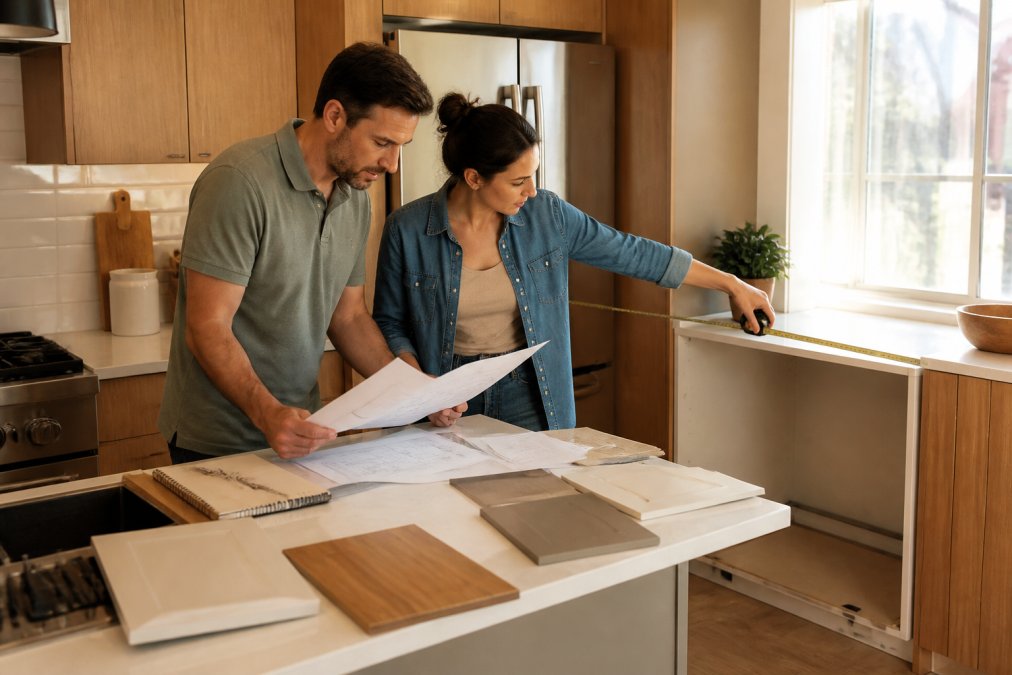
Selection comes first because everything downstream depends on it. Measure your rough-in dimensions, confirm your electrical capacity, and photograph your existing plumbing hookups before you walk into a showroom.
What most guides miss is that this phase is about constraints, not wish lists. A Department of Energy guide to appliance energy use helps you compare energy-efficient models, but the model you can actually install is the one your space, wiring, and ventilation requirements allow.
Phase 2: Ordering and Lead Times (4-8 Weeks Out)
Ordering early protects your schedule. Supply chain volatility hit appliance categories hard in recent years, and specialty finishes like custom panel-ready fronts still run longer than stainless steel.
- Confirm delivery date in writing before demolition begins
- Verify the model number matches your spec sheet exactly
- Ask whether installation is included or quoted separately
- Check warranty coverage start date, which should begin at installation, not purchase
Standard Kitchen Appliance Dimensions and Site Conditions
Standard kitchen appliance dimensions are starting points, not guarantees. Counter-depth refrigerators typically run shallower than standard-depth models, and built-in appliances require precise rough-in dimensions that vary by manufacturer. The real work is confirming that your site conditions, electrical capacity, plumbing, ventilation, and cabinet cutouts, can actually accept the model you want.
Site conditions decide what's installable. The table below maps each appliance category to the site requirement that most often derails a remodel, plus the mechanism behind the failure.
| Appliance | Key Site Requirement | Common Oversight | Why It Fails |
|---|---|---|---|
| Induction cooktop | Dedicated 240V circuit, typically 40-50 amps for a full-size unit | Shared circuit with other kitchen loads | Breaker trips under simultaneous load; retrofit requires a new home run to the panel |
| Wall oven | Rough-in depth, cabinet cutout, and a dedicated 240V circuit | Cutout sized to the old oven, not the new spec sheet | Cabinet modification after fabrication; often a full cabinet replacement |
| Dishwasher | Hot water supply, drain access, and an air gap or high loop | No disposal clearance or no air gap | Backflow code violation; re-plumbing behind finished cabinets |
| Over-range microwave | Ducted vs. recirculating ventilation path | Recirculating unit specified where a duct was expected | Grease and moisture recirculate into the kitchen; duct chase must be cut later |
| Freestanding range | Correct fuel hookup (gas line or 240V) | Wrong fuel line installed during rough-in | Gas-to-electric or electric-to-gas conversion after drywall |
| Refrigerator | Width, depth, height, door swing, and water line | Measured width only, ignoring depth and hinge clearance | Fridge protrudes past counters or doors hit adjacent cabinetry |
Rough-In Dimensions and Installation Requirements
Rough-in dimensions are the measurements your cabinets, walls, and utility connections must satisfy before an appliance can be installed. Getting these wrong is the most expensive kind of error because it usually means modifying finished cabinetry.
Pull the spec sheet for every model on your list and hand those numbers to your contractor before fabrication starts. A standard dimension from one brand rarely matches another brand's "standard." Three numbers matter most:
- Cutout dimensions, the actual opening the appliance requires, not the appliance's exterior size.
- Clearance requirements, the air gap the manufacturer specifies around the unit for ventilation and door swing.
- Utility stub locations, where the electrical box, gas valve, and water supply must land relative to the cutout.
Electrical, Plumbing, and Ventilation Capacity
Before you commit to a model, verify three systems:
- Electrical panel capacity. A full induction cooktop plus a wall oven plus a microwave can exceed what a 100-amp service comfortably supports (Home Upgrades). An electrician can confirm available amperage and whether a subpanel or service upgrade is needed.
- Plumbing rough-in. Dishwashers, ice makers, and pot fillers each need a supply line and drain path. Moving a sink during a remodel often means relocating the dishwasher supply and drain too.
- Ventilation duct path. A professional-grade range hood needs a duct routed to the exterior. Duct diameter, run length, and the number of elbows all affect performance, and the path must be planned before drywall goes up.
How to Choose Kitchen Appliances: A Decision Framework
Choosing kitchen appliances comes down to three filters applied in order: fit, function, then finish. Most buyers reverse that order and end up returning something.
Fit means rough-in dimensions, electrical capacity, and ventilation requirements all check out. Function means the appliance matches how you actually cook, not how you imagine you cook. Finish means the stainless steel, black stainless, or panel-ready fronts match across brands, which is harder than it sounds.
Appliance Packages vs. Mix-and-Match
An appliance package bundles multiple units from one brand, usually at a better combined value and with guaranteed finish matching. Mix-and-match lets you pick the best model in each category, but you'll pay more and risk subtle finish mismatches.
Smart Home Integration and Connectivity
Smart features matter most when they solve a real problem: preheating an oven remotely, getting a leak alert from a dishwasher, or monitoring a refrigerator's temperature while traveling. Connectivity is a genuine differentiator, but only if your WiFi reaches the kitchen reliably.
Check three things before buying a connected appliance: whether it needs a hub, whether the app works with your phone's platform, and whether the manufacturer commits to software updates. A smart fridge with abandoned firmware becomes a dumb fridge within a few years.
If you buy a connected appliance from The Appliance Wizard, our team helps with setup and confirms the WiFi connection works before we leave.
Supply Chain, Lead Time Management, and Long-Term Serviceability
Lead time management is where remodels quietly fail. Custom panel-ready refrigerators and professional-grade ranges routinely take longer than freestanding units, and a missed delivery date can idle an entire crew.
Serviceability is the angle almost nobody covers. Before you buy, ask who repairs the unit locally, whether genuine replacement parts are readily available, and how long the manufacturer commits to stocking them. An appliance nobody can service is a future problem, not a bargain.
The Appliance Wizard maintains an in-house repair team and a stock of genuine replacement parts, which means a warranty issue doesn't turn into a weeks-long wait for a third-party technician.
Budgeting and Financing Your Appliance Package
Appliance budgeting fails when it starts with a number instead of a structure. The workable approach is to build the budget from the bottom up: identify the cost drivers, allocate by usage priority, then layer financing on top.
The Cost Drivers That Move the Number Most
Four variables account for most of the spread between a modest and a high-end appliance package:
- Category mix. A full kitchen package typically includes a refrigerator, range or cooktop-plus-oven, dishwasher, over-range microwave or hood, and often a disposal. Adding a beverage center, wine fridge, or second oven changes the total significantly.
- Built-in vs. freestanding. Built-in and panel-ready appliances cost more than freestanding equivalents and require more precise cabinetry work, which adds labor.
- Finish and brand tier. Panel-ready fronts, professional-style ranges, and premium brands carry a premium over standard stainless steel.
- Installation scope. Delivery, haul-away, electrical work, plumbing modifications, and ductwork are often quoted separately. Confirm what's included before comparing quotes.
A Workable Allocation Framework
Rather than quoting a single figure, work backward from your total kitchen budget:
- Subtract fixed costs first: cabinetry, countertops, labor, permits, and any structural or electrical work.
- What remains is your appliance envelope.
- Allocate the largest share to the appliances you use daily, range, refrigerator, dishwasher.
- Fund secondary appliances (microwave, beverage center, second oven) from what's left, or defer them to a later phase.
A common pattern is to overspend on the refrigerator and range while underfunding ventilation and installation labor, which are the items most likely to cause change orders.
Where to Save Without Regretting It
- Refurbished or scratch-and-dent units for secondary appliances can reduce cost meaningfully, provided the warranty is intact.
- Package pricing often bundles multiple units from one brand at a better combined value and guarantees finish matching.
- Rebates and utility incentives for energy-efficient models vary by region and program; check eligibility before purchase.
- Price matching can close the gap between a local dealer and a big-box quote without sacrificing service.
Financing: Read the Terms, Not the Headline
Financing terms matter more than the promotional rate. Confirm in writing:
- Whether the promotional rate carries deferred interest, meaning interest accrues from day one and is charged in full if the balance isn't paid within the promo window.
- The regular APR that applies after the promotional period ends.
- Whether early payoff carries any penalty.
- Whether the financing is tied to a specific card or credit line.
At The Appliance Wizard, we offer flexible financing and price match, so a full package stays budget-friendly without hidden loopholes.
Conclusion
The hardest part of an appliance remodel isn't picking a brand. It's sequencing selection, ordering, installation, and service so nothing stalls your project.
The Appliance Wizard handles that sequence for Southern Illinois homeowners with expert product advice, professional installation, in-house repair, and genuine replacement parts. Our factory-trained technicians install what we sell, and our price match and financing options keep the package affordable. Visit one of our Marion or Carbondale showrooms or browse packages online to get started.
Frequently Asked Questions
What is the 30% rule in remodeling and how does it apply to appliances?
The 30% rule is a budgeting guideline that suggests you should not spend more than 30% of your home's value on a remodel, but for appliances specifically, many experts recommend allocating 10-15% of your total remodel budget. For a $50,000 kitchen, that means $5,000 to $7,500 for appliances. This range covers mid-range to premium options, but you can adjust based on whether you choose refurbished or standard models. Always factor in installation and potential electrical or plumbing updates.
Should I buy my appliances before or after starting a kitchen remodel?
Buy appliances before demolition begins, ideally 8-12 weeks out. This ensures you have exact rough-in dimensions for cabinetry and countertops, and it accounts for supply chain delays. Ordering early also lets you lock in pricing and avoid backorders. However, coordinate delivery for after the kitchen is ready to avoid damage or theft. A local appliance specialist can help you time the order and delivery with your contractor's schedule.
How do I ensure my new appliances fit my existing kitchen layout?
Measure your current space and compare it to the manufacturer's spec sheet for each appliance. Pay attention to rough-in dimensions: width, height, depth, and clearance for doors and ventilation. Standard dimensions like 30 inches for ranges and 24 inches for dishwashers are common, but always verify. Also check that your electrical panel, gas lines, and plumbing hookups can accommodate the new units. A professional installer can assess site conditions and flag any modifications needed before you buy.
What should I look for in a smart appliance to ensure it connects to my home WiFi?
Check that the appliance supports the same WiFi band as your router (2.4 GHz is common, but some use 5 GHz) and uses a standard app like SmartThings, Alexa, or Google Home. Look for models with clear setup instructions and a dedicated support line. Before buying, ask if the retailer offers in-home setup and connectivity testing. A local provider like The Appliance Wizard can confirm compatibility and help you avoid a fridge that won't pair with your network.