 blog
7 Ways to Fix a Dishwasher Not Draining Water
Table of Contents
- Why Your Dishwasher Isn't Draining Water
- How to Clean Your Dishwasher Filter
- Fix a Dishwasher Drain Hose Clog
- Remove Standing Water From the Basin
- Inspect the Garbage Disposal Connection
- Check the Drain Pump and Impeller
- Verify the Air Gap and Drain Valve
- When to Call Reliable Dishwasher Repair Near Me
- Prevent Future Drainage Problems
- Frequently Asked Questions
Last Updated: September 28, 2026
Why Your Dishwasher Isn't Draining Water
A dishwasher not draining water is one of the most common appliance problems homeowners face. Standing water in the basin after a cycle means food debris, soap residue, and bacteria are sitting in your machine. This isn't just gross, it damages your dishwasher and creates foul odors that spread to your dishes and kitchen.
The good news: most drainage issues are fixable without calling a repair technician. Many of these fixes take less than an hour and require only basic tools.
A dishwasher not draining typically stems from one of seven specific problems. Clogs in the filter, drain hose, or garbage disposal connection are the most common culprits. But mechanical issues like a stuck drain pump or a faulty drain valve can also prevent water from leaving the basin.
This guide walks you through each fix in order of likelihood. Start with the easiest troubleshooting steps first, cleaning the filter usually solves the problem. If that doesn't work, move down the list until you find the blockage or mechanical failure.
How to Clean Your Dishwasher Filter
The filter assembly is the first place to check when your dishwasher not draining. This mesh screen catches food particles, grease, and debris before they enter the drain line. When it clogs, water backs up in the basin.
Most dishwashers have a removable filter at the bottom of the tub. Here's how to clean it:
- Stop the cycle. Open the door and let the water drain as much as it can.
- Locate the filter. Look at the bottom center of the tub. You'll see a cylindrical or flat mesh screen.
- Remove the filter. Twist it counterclockwise or pull it straight up, depending on your model.
- Rinse under hot water. Hold it under running water and scrub away debris with a soft brush or cloth.
- Check for damage. Look for tears or cracks in the mesh. If damaged, order a replacement.
- Reinstall the filter. Push it back down and twist clockwise until it locks.
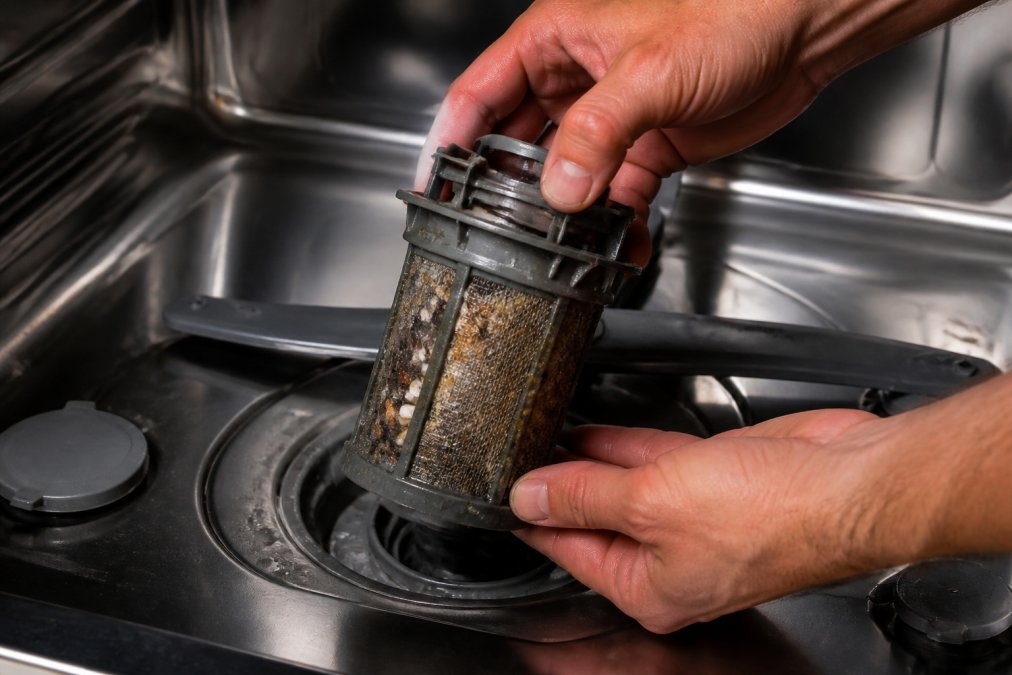
A clogged filter is responsible for most drainage problems. If water still pools after cleaning the filter, move to the next step. Don't assume the filter is clean just because it looks okay, run your fingernail across the mesh to feel for buildup that water spray alone won't remove.
Hard water deposits can also block the tiny filter holes. Soak the filter in white vinegar for 30 minutes, then scrub again. This dissolves mineral buildup that plain water can't shift.
Fix a Dishwasher Drain Hose Clog
The drain hose carries water from the tub to your sink or garbage disposal. A kinked, pinched, or clogged drain hose stops water from flowing out completely.
Start with a visual inspection:
- Pull the dishwasher out from under the counter.
- Trace the drain hose from the back of the unit to where it connects to the sink or disposal.
- Look for kinks, cracks, or obvious blockages.
- Check that the hose isn't pinched between the dishwasher and cabinet wall.
If the hose is kinked, straighten it carefully. Kinks restrict water flow and can trap debris.
For a clogged drain hose:
- Disconnect the hose. Use a bucket to catch water. Loosen the clamp where the hose meets the dishwasher and the sink connection.
- Flush with hot water. Point the hose into a bucket and pour hot water through it. If water doesn't flow freely, debris is blocking it.
- Use a wet-dry vacuum. Place the vacuum hose over the drain hose opening and run it on suction mode for 10-15 seconds. This pulls out clogs.
- Check the high loop. If your drain hose runs up before dropping down to the sink, make sure this high loop is still in place. It prevents water from flowing backward into the dishwasher.
- Reconnect and tighten. Reattach the hose and secure the clamp firmly.
A drain hose clog often happens when food particles, grease, or hard water deposits accumulate inside the line. If the hose is cracked or damaged, replace it rather than trying to patch it. Replacement hoses are available for most major dishwasher brands.
Remove Standing Water From the Basin
If your dishwasher not draining has left water sitting in the tub, you need to remove it before continuing troubleshooting. Standing water prevents you from accessing the filter and drain components.
Here's how to drain the basin:
- Use the cancel or drain cycle. Check your dishwasher manual for a "Drain" or "Cancel" button. Press it to run the drain pump and remove water.
- Scoop water manually. If no drain cycle exists, use a wet-dry vacuum to suction out the water. Place the vacuum hose at the lowest point of the tub and run it until the basin is empty.
- Towel dry the bottom. Use old towels to absorb remaining water. This gives you a dry workspace for the next steps.
Once the basin is empty, you can see exactly where water is pooling. If it collects in one corner, the drain outlet in that area is likely blocked. If it spreads across the bottom, the issue is further down the drainage system.
Never use a regular household vacuum to remove dishwasher water. The moisture will damage the motor. A wet-dry vacuum is designed for this and costs around $50-100 if you don't already own one.
Inspect the Garbage Disposal Connection
Many dishwashers drain into the garbage disposal, which then sends water down the main kitchen drain. If the disposal is clogged or blocked, your dishwasher can't drain.
Check the garbage disposal:
- Look at the drain cap. Most dishwashers connect to the disposal through a rubber or plastic cap inside the disposal opening.
- Remove the cap if accessible. Some caps pull out by hand. If stuck, use pliers to gently pry it loose.
- Check for blockages. Shine a flashlight into the disposal and look for food debris, grease, or buildup.
- Run the disposal. Fill the sink with a few inches of water, turn on the disposal, and listen. If it grinds slowly or makes a grinding noise, something is stuck inside.
- Clear the blockage. Turn off the disposal completely. Use tongs or pliers to pull out visible debris. Never put your hands inside.
- Flush with hot water. Run hot water down the disposal for 30 seconds to clear remaining particles.
If the disposal is jammed and won't turn, it needs professional service. Our factory-trained technicians can unjam disposals and clear blockages safely.
The connection between your dishwasher and disposal should be clear and unobstructed. If the rubber cap is missing or damaged, replace it. This cap prevents air from entering the dishwasher drain line, which can cause suction problems.
Check the Drain Pump and Impeller
The drain pump is a small motor that forces water out of the dishwasher. The impeller is a spinning blade inside the pump that creates suction. If either fails, water stays in the basin. However, not every pump that sounds wrong is broken, many apparent failures are actually debris blockages or temporary motor stalls that you can clear yourself.
Diagnosing pump problems: three-step test
Before assuming the pump has failed, run this diagnostic sequence:
-
Listen during the drain cycle. Start a drain or cancel cycle and listen carefully. A healthy pump is nearly silent or makes a soft whirring sound. Note what you hear:
- Humming with no water movement: The motor is running but the impeller is stuck. This is often fixable.
- Grinding or squealing: Metal-on-metal friction or a seized bearing. This usually means pump replacement.
- Clicking or rattling: Debris hitting the impeller blades. This is fixable.
- Complete silence: The pump motor isn't receiving power. Check the control board or thermal fuse (see error code section below).
-
Feel for vibration. Place your hand on the pump housing (located at the bottom center of the tub, beneath the filter). A working pump vibrates slightly during the drain cycle. No vibration suggests an electrical failure, not a mechanical clog.
-
Attempt manual rotation. If safe to access (see below), try to rotate the impeller by hand. A stuck impeller that won't budge even with gentle pressure indicates a seized bearing or internal damage.
Accessing and clearing the impeller
To inspect the drain pump:
- Unplug the dishwasher. Always disconnect power before accessing internal components.
- Access the pump. This usually means removing the bottom panel or front kick plate. Check your manual for the exact location and fastener type (usually Phillips or hex-head screws).
- Look for debris. Shine a flashlight into the pump area. Food particles, glass shards, or hard plastic pieces can jam the impeller.
- Clear blockages carefully. Use tweezers or needle-nose pliers to remove any debris around the impeller blades. Be gentle, the impeller is delicate and can crack if forced. Do not use water or compressed air, as this can push debris deeper into the pump housing.
- Spin the impeller by hand. Gently rotate it with your finger. It should move freely with minimal resistance. If it's stuck or won't move at all even after debris removal, the pump is likely failed.
- Reassemble and test. Replace the panel, plug in the dishwasher, and run a drain cycle. If water now drains, the blockage was the culprit.
When the pump is truly failed
If the impeller won't rotate after debris removal, or if you hear grinding and the pump doesn't respond to cleaning, the pump motor or internal seal has failed. Replacement is required. This is not a DIY repair, the pump is sealed and requires specialized tools to remove without damaging the dishwasher tub or drain lines. Professional replacement is required.
Error codes and pump failure
Many modern dishwashers display error codes when the pump fails. Common codes include:
- E24 or DE (Bosch, Siemens, LG): Drain pump error
- F02 (GE, Hotpoint): Drain system fault
- 5E (Samsung): Drain error
- OE (Whirlpool, Maytag, Amana): Overflow or drain error
If your dishwasher displays one of these codes, the control board has detected a pump malfunction. The pump may still be repairable if the issue is electrical (a loose wire or failed thermal fuse) rather than mechanical. Check that all hoses are connected and the filter is clean before concluding the pump itself is broken.
Verify the Air Gap and Drain Valve
The air gap is a small chrome fitting on the edge of your sink or countertop. It prevents dirty drain water from flowing backward into your dishwasher. A clogged air gap stops drainage completely.
To clean the air gap:
- Locate it. Look at the back corner of your sink. The air gap looks like a small cylinder, usually 1-2 inches tall.
- Unscrew the cap. Most air gaps have a removable cap on top.
- Check for debris. Look inside. You'll likely see food particles, grease, or mineral buildup.
- Clean it out. Use a small brush or pipe cleaner to scrub the inside walls. Rinse with hot water.
- Flush the tube below. Disconnect the hose that runs from the air gap to the disposal. Flush it with hot water to clear any blockage.
- Reassemble. Reconnect the hose and screw the cap back on.
The drain valve is a one-way flapper inside the dishwasher that opens to let water out and closes to keep it in. A stuck or failed drain valve prevents water from leaving the basin.
Checking the drain valve requires accessing the pump area. Look for a small flapper or ball inside the drain outlet. If it's stuck closed, you may hear water rushing when the drain cycle runs, but none exits the tub. A stuck valve often responds to gentle cleaning with vinegar and a small brush. If it remains stuck, the valve needs replacement.
When to Call Reliable Dishwasher Repair Near Me
Some drainage problems require professional tools and expertise. Know when it's time to call for help:
- The drain pump makes grinding, squealing, or unusual noises.
- Water still won't drain after you've cleaned the filter, hose, and air gap.
- You've removed standing water three times and it keeps returning.
- The dishwasher motor runs but no water moves during the drain cycle.
- You see cracks in the drain hose or pump housing.
The Appliance Wizard provides professional dishwasher repair service across Southern Illinois. Our factory-trained, certified technicians diagnose drainage issues quickly and repair them right the first time.
When you call, have your dishwasher model number ready. It's usually on a sticker inside the tub edge or on the back of the unit. This helps us bring the correct replacement parts and speeds up your service appointment.
Prevent Future Drainage Problems
A drainage maintenance schedule keeps your dishwasher running smoothly and prevents costly repairs. The most overlooked maintenance issue is hard water mineral buildup, which silently degrades drainage performance over months until the system fails completely.
How hard water damages drainage
Hard water contains dissolved calcium and magnesium minerals (Hardness of Water). When dishwasher water heats to 130-140°F during the wash cycle, these minerals precipitate out and form crusty deposits on internal surfaces. Over time, these deposits accumulate inside the filter mesh, drain pump impeller, and drain valve, restricting water flow. The deposits are not visible from outside and don't show up until drainage slows noticeably or stops entirely.
If your water hardness exceeds 120 parts per million (ppm), check your local water utility report online, mineral buildup is accelerating in your dishwasher. Hard water also reduces detergent effectiveness, so dishes come out spotty and cloudy even if water drains normally.
Monthly maintenance
- Run a descaling cycle: Once per month, run an empty hot-water cycle with one cup of white vinegar (5% acidity) poured into the bottom of the tub. Do not use the detergent dispenser. The vinegar dissolves fresh mineral deposits before they harden and prevents grease from coating the pump. This single step helps maintain your drainage system.
- Inspect and rinse the filter: Remove the filter assembly and rinse it under hot running water. Use a soft brush to scrub the mesh. If you see white or tan crusty buildup, soak the filter in white vinegar for 30 minutes, then scrub again. This removes mineral deposits that plain water won't shift.
- Check the spray arms: Look at the spray arm holes (usually on the sides and bottom of the tub). If any holes are blocked by food debris or mineral deposits, use a toothpick to clear them. Blocked spray arms reduce water pressure and drainage efficiency.
- Wipe the door seal: Remove food particles and mold from the rubber gasket around the door. Mold doesn't affect drainage directly, but it indicates moisture retention, which accelerates mineral buildup.
Quarterly maintenance
- Inspect the drain hose: Pull the dishwasher out from under the counter and trace the drain hose from the back of the unit to the sink or disposal. Look for kinks, cracks, or white mineral crusting on the outside of the hose. If the hose is kinked, straighten it. If it's cracked or heavily crusted, replace it.
- Clean the air gap cap and tube: Locate the air gap (small chrome cylinder on the back corner of your sink). Unscrew the cap and look inside. You'll likely see mineral deposits, grease, or food particles. Use a small brush or pipe cleaner to scrub the inside walls and the tube that runs from the air gap to the disposal. Rinse with hot water.
- Descale the pump area: If you're comfortable accessing the pump (see drain pump section), use a soft brush and white vinegar to gently clean mineral deposits from the impeller and pump housing. Do not use abrasive scrubbers or force.
Annually
- Run a commercial descaler: Use a dishwasher-specific descaling product (such as those designed for Bosch, Miele, or LG models) according to package directions. These products are stronger than vinegar and dissolve heavy mineral buildup more effectively. Run the cycle with an empty tub.
- Professional inspection: If your dishwasher is over five years old or you have very hard water (over 200 ppm), consider having a professional inspect the drain pump, valve, and hose for mineral deposits. Early detection can help prevent emergency repairs.
Hard water mitigation strategies
- Use rinse aid in every cycle. Rinse aid reduces mineral spotting on dishes and also reduces mineral accumulation inside the machine. Fill the rinse aid dispenser and set it to the highest level.
- Install a water softener. A whole-house water softener removes minerals before water enters your dishwasher. This is an effective long-term solution for hard water problems.
- Use a dishwasher inlet water filter. Some models allow you to install a sediment or mineral filter on the water inlet line. This catches some minerals before they enter the machine, though it doesn't eliminate the problem entirely.
Maintenance schedule at a glance
| Maintenance Task | Frequency | Time Required | Benefit | Hard Water Priority |
|---|---|---|---|---|
| Clean filter | Monthly | 5 minutes | Prevents clogs | High |
| Run vinegar cycle | Monthly | 2 hours | Dissolves mineral deposits | Critical |
| Inspect drain hose | Quarterly | 10 minutes | Catches kinks and mineral crusting early | High |
| Clean air gap | Quarterly | 10 minutes | Maintains suction and prevents backflow | Medium |
| Run commercial descaler | Annually | 2 hours | Deep clean of pump and valve | Critical if hardness >150 ppm |
| Professional inspection | Annually | 1 hour | Catches pump failure and heavy deposits | High if hardness >200 ppm |
Frequently Asked Questions
What is the most common reason a dishwasher won't drain?
A clogged filter is the leading cause of standing water in dishwashers. Food debris, grease, and mineral buildup accumulate in the filter assembly over time, blocking water flow through the drainage system. Checking and cleaning the filter should be your first troubleshooting step. If the filter is clean, the issue often lies in the drain hose, garbage disposal connection, or drain pump impeller.
How often should I clean my dishwasher filter to prevent drainage issues?
Clean your dishwasher filter monthly as part of preventative maintenance, or more frequently if you load heavily soiled dishes. Hard water deposits and food particles accumulate faster in areas with mineral-rich water. Regular cleaning prevents blockages in the filter assembly and keeps your drainage system functioning properly. Monthly maintenance takes just 5-10 minutes and eliminates most drainage problems before they start.
Is it safe to run a dishwasher with standing water in it?
No. Running your dishwasher with standing water can damage the drain pump and impeller, creating expensive repairs. Standing water also indicates a blockage in your drainage system, likely in the filter, drain hose, or drain pump. Stop using the appliance until you've identified and cleared the clog. If water doesn't drain after trying these fixes, contact a professional to avoid pump failure.
When should I call a professional for dishwasher repair?
Contact a technician if standing water remains after you've cleaned the filter, checked the drain hose for kinks, cleared the garbage disposal, and verified the air gap. If you hear grinding noises from the drain pump or see error codes on your display, the impeller or pump likely needs replacement. Professional service ensures proper diagnosis and prevents further damage to your appliance's drainage system.