 blog
Where to Buy Refurbished Washers: 2026 Buyer's Guide
Table of Contents
- Where to Buy Refurbished Washers: The 2026 Landscape
- Certified Refurbished vs. Used: What the Labels Actually Mean
- How to Inspect a Refurbished Washing Machine Before You Pay
- Where to Find Affordable Scratch and Dent Appliances
- Certified Refurbished Washer Warranty: What You Get and What You Don't
- Total Cost of Ownership: Refurbished vs. New Over 10 Years
- Scratch and Dent vs. Refurbished: Which Grade Fits Your Budget?
- Energy Efficiency and Load Capacity: What to Check on the Label
- Frequently Asked Questions
Last Updated: September 24, 2026
Where to Buy Refurbished Washers: The 2026 Landscape
Shopping for refurbished washers means choosing between several distinct supply channels, each with its own grading standards, return policies, and warranty terms. The channel you pick matters more than the brand on the lid.
At The Appliance Wizard, we've watched the refurbished appliance market shift from a niche sideline to a mainstream option for budget-conscious homeowners. Buyers today can find factory-tested units through appliance outlets, independent dealers, and certified refurbishment programs. What separates a good purchase from a costly mistake is understanding how each seller defines "refurbished."
A washer that's been properly reconditioned and tested can deliver years of reliable service at a fraction of new-unit cost. A washer that's simply been wiped down and resold is a repair bill waiting to happen. The difference often comes down to where you shop and what questions you ask before handing over a card.
Below, we'll show you exactly how to tell the two apart, which channels offer real protection, and what a 10-year cost comparison actually looks like.
Certified Refurbished vs. Used: What the Labels Actually Mean
Certified refurbished means the appliance was returned to a manufacturer or authorized refurbisher, inspected, repaired with genuine parts where needed, tested against performance standards, and resold with a limited warranty. Used means someone owned it, and now someone else is selling it, with no testing standard behind the label.
That gap is enormous in practice. A certified unit typically goes through appliance testing that covers the motor, pump, control board, and water inlet valves. A used unit sold through a classified listing has passed no such checks. You're buying the seller's word.
Here's how the common labels stack up:
- Certified refurbished: factory-tested, repaired to like-new condition, backed by a limited warranty
- Reconditioned: repaired and cleaned by a dealer, testing depth varies by seller
- Open-box: returned unused or barely used, original packaging may be damaged
- Scratch and dent: new appliance with cosmetic flaws, full manufacturer warranty usually intact
- Second-hand: previously owned, sold as-is with no performance guarantee
A common mistake is treating "reconditioned" and "certified refurbished" as synonyms. They aren't. Only one implies a documented testing process and a warranty you can enforce.
How to Inspect a Refurbished Washing Machine Before You Pay
Inspect a refurbished washing machine by testing the drum, checking for leaks and odors, verifying the control panel, and confirming the model's age and parts availability. A 10-minute inspection catches most problems that would otherwise surface in the first month.
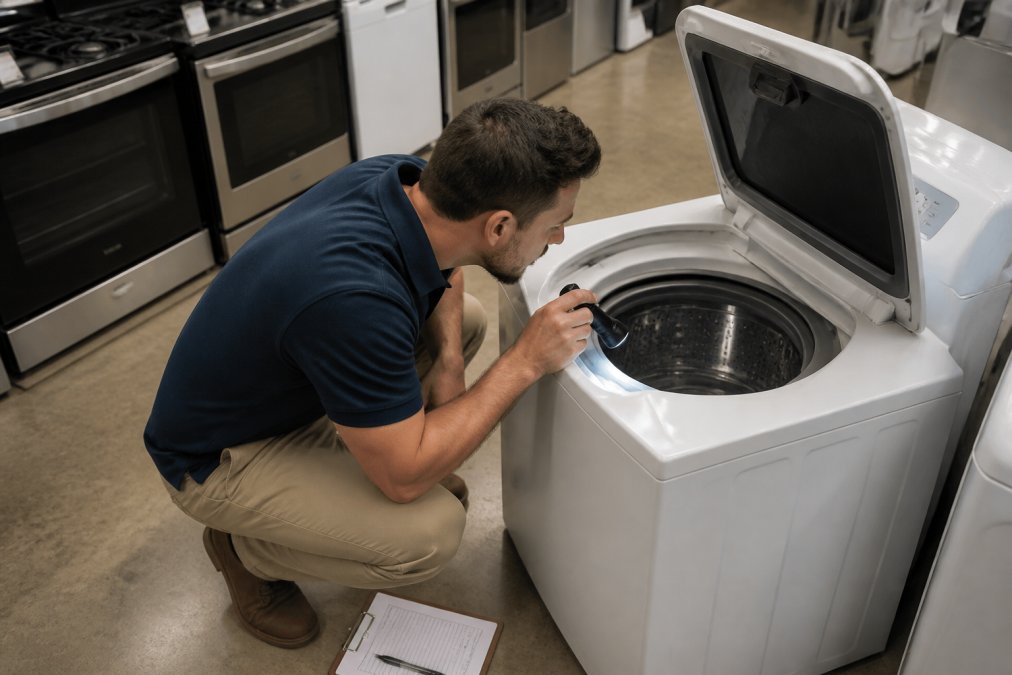
The 10-Point Diagnostic Checklist
Run through this before money changes hands:
- Spin the drum by hand. It should rotate smoothly with no grinding or wobble.
- Check the door seal or lid gasket for cracks, mold, or stiffening.
- Look for rust around the drum, base, and door hinge.
- Smell the interior. A sour or mildew odor signals trapped moisture and poor cleaning.
- Run a short cycle if the seller allows it. Listen for unusual noise during the spin phase.
- Test every control and dial. Buttons should respond immediately, not require a second press.
- Inspect the water inlet hoses and drain hose for cracks or kinks.
- Verify the model and serial number and look up the appliance lifespan for that line.
- Check the drain pump filter for debris that suggests neglected maintenance.
- Confirm the warranty terms in writing before you leave the store.
Skip the cycle test and you're gambling. Most dealers who stand behind their inventory will run it for you without hesitation.
Where to Find Affordable Scratch and Dent Appliances
Affordable scratch and dent appliances show up most often at independent appliance outlets, dealer clearance floors, and manufacturer-certified refurbishment programs. These units are usually new, fully functional, and discounted because of a dent on the side panel or a scratch on the door.
The appeal is obvious: you get a new machine with a full manufacturer warranty, and the damage is cosmetic. If the washer sits against a wall or under a counter, nobody sees the flaw anyway.
Where to Look
- Independent appliance dealers often carry scratch and dent inventory alongside new stock
- Appliance outlet stores buy discontinued and cosmetically flawed units in bulk
- Authorized retailer clearance events move open-box and display models at reduced prices
- Manufacturer direct programs sell certified refurbished units with factory backing
What most guides miss is that scratch and dent stock moves fast. A dented front-load washer at a steep discount rarely sits on the floor for more than a week or two. If you find one that fits your space and budget, decide quickly.
The Verification Step Nobody Talks About
Before you buy any unit labeled "scratch and dent," confirm what the label actually means at that seller. The term is not regulated, and it gets applied loosely. Ask three questions:
- Is the unit new or returned? True scratch and dent is a new appliance with cosmetic damage. If it was returned after use, it's not scratch and dent, it's refurbished or used, and the warranty terms may differ.
- Is the manufacturer warranty intact? On a genuinely new scratch-and-dent unit, the full manufacturer warranty usually still applies because the appliance was never owned. If the seller says the warranty is void, the unit is not what the label claims.
- What caused the damage? A dent from shipping is cosmetic. A dent from a drop that also damaged internal components is not. Ask whether the unit was function-tested after the damage occurred.
Scratch and Dent vs. Refurbished: The Practical Difference
The distinction matters because it determines your risk:
- Scratch and dent is a new appliance with cosmetic flaws. Mechanically it should be identical to a flawless unit, and the manufacturer warranty typically covers it.
- Refurbished is a previously owned or returned appliance that was repaired and tested. It carries a shorter, seller-provided warranty and a history you can't fully see.
If a seller is pricing a refurbished unit as scratch and dent, or vice versa, that's a red flag about how they grade inventory. Ask for the documentation that supports the label.
Why a Local Dealer Beats a Warehouse Floor Here
A store with in-house repair and service can tell you exactly what's wrong with a unit and what it'll take to fix it. That's harder to get from a warehouse floor where staff may not know the unit's history. When you're buying a cosmetically flawed appliance, the seller's ability to vouch for its mechanical condition is worth more than a few dollars of additional discount.
Certified Refurbished Washer Warranty: What You Get and What You Don't
A certified refurbished washer warranty typically covers parts and labor for a limited period, often 90 days to one year, depending on the refurbisher. It rarely matches the multi-year coverage that comes with a new appliance.
Read the fine print on three things:
- Duration. How long does coverage last from the purchase date?
- Scope. Does it cover parts and labor, or just parts?
- Exclusions. Cosmetic flaws, water damage, and improper installation are commonly excluded.
An extended coverage plan can bridge the gap if the standard warranty feels thin. Just compare the plan's cost against the risk. On a machine priced well below new, a modest extended plan often makes sense; on a unit already near new pricing, it may not.
Consumer protection rules vary by state, and some protections attach to the sale regardless of what the seller's paperwork says. The FTC's guidance on warranty and consumer rights is worth a look before you sign anything, especially if a seller tries to disclaim all responsibility.
Total Cost of Ownership: Refurbished vs. New Over 10 Years
Total cost of ownership for a washer is the purchase price plus every dollar you spend keeping it running: repairs, parts, labor, energy, and the eventual replacement. Most buying guides stop at the sticker price. That's the wrong number to optimize.
Here's the framework that actually predicts which machine costs less over a decade.
The Four Cost Buckets
1. Acquisition cost. The price you pay at the register, plus delivery and installation if they aren't bundled. A refurbished unit typically lands well below a comparable new model, and that gap is the entire reason the category exists.
2. Repair cost and frequency. This is where refurbished units separate from each other. A machine that was reconditioned with a new pump, belt, and door seal has already had its most failure-prone wear parts replaced. A machine that was only cleaned and tested has not. Ask the seller which components were replaced, not just inspected.
3. Energy and water cost. Operating cost scales with how often you run the machine and how efficient it is. An older top-loader can use substantially more water per cycle than a modern high-efficiency front-loader. Over years of weekly use, that difference compounds. The yellow EnergyGuide label gives you the estimated annual operating cost, so use it.
4. Replacement timing. Every appliance has an expected service life. A refurbished unit is already partway through that life, so its remaining runway is shorter than a new unit's. That's not a dealbreaker, it's a planning input.
How to Run the Math for Your Situation
You don't need a spreadsheet, but you do need four inputs:
- Purchase price of the refurbished unit versus the new unit you'd otherwise buy
- Expected annual energy cost from the EnergyGuide label on each
- Your assumed repair budget per year (a reasonable planning figure is one service call every few years on a refurbished unit, more if it came without a warranty)
- Years you expect to keep it before replacement
Multiply annual energy cost by years, add your repair budget across the same period, add the purchase price, and compare the two totals. The refurbished unit usually wins on the front end by a wide enough margin to absorb a repair or two. The new unit usually wins if you plan to keep the machine long enough that the refurbished unit needs replacing while the new one is still running.
The Variables That Flip the Answer
A few conditions change which option wins:
- No warranty on the refurbished unit. Without coverage, a single major repair (control board, transmission, motor) can erase the upfront savings. This is the biggest swing factor.
- Very old refurbished unit. The older the machine, the closer it is to end of life and the more likely parts are discontinued.
- High-efficiency new model in a high-usage household. The more loads you run per week, the more the energy difference matters, which favors the newer machine.
- Short ownership horizon. If you're buying for a rental or plan to move in a few years, the refurbished unit's lower upfront cost dominates because you won't own it long enough to hit the replacement cliff.
What Most Guides Get Wrong
They frame refurbished versus new as a simple price comparison. It isn't. The real question is whether the upfront savings exceed the sum of earlier repairs, higher operating cost, and a shorter remaining lifespan. For a warrantied refurbished unit bought from a dealer who replaced the wear parts, the answer is usually yes. For an as-is unit with an unknown history, the answer is usually no.
Run the four-bucket math before you decide the lower price is the better deal.
Scratch and Dent vs. Refurbished: Which Grade Fits Your Budget?
Scratch and dent is best for buyers who want a new, fully warranted appliance at a discount and don't mind cosmetic flaws. Refurbished is best for buyers who want the lowest upfront price and are willing to accept a shorter warranty and a machine with prior use.
Neither is "better" in the abstract. It comes down to what you value:
- Choose scratch and dent if you want a full manufacturer warranty, a like-new machine mechanically, and can live with a dent or scratch.
- Choose refurbished if the lowest price matters most and you're comfortable with a limited warranty.
- Choose open-box if you want near-new condition with a modest discount and the original accessories.
- Avoid second-hand as-is unless you can inspect and test the unit yourself, or you know the seller.
For a rental property or a laundry room where the machine is out of sight, scratch and dent is usually the smarter call. For a tight budget where every dollar counts, refurbished from a reputable dealer is the pragmatic pick.
Energy Efficiency and Load Capacity: What to Check on the Label
Energy efficiency and load capacity are the two specs that determine how well a washer fits your household and your utility bill. Both appear on the yellow EnergyGuide label and the machine's spec sheet.
Check these before you buy:
- Energy efficiency rating. Higher efficiency means lower operating cost over the machine's life.
- Load capacity. Measured in cubic feet, this determines how much laundry fits per cycle.
- Cycle options. More cycles give you flexibility for delicates, heavy duty, and quick washes.
- Washer type. Front-load models typically use less water; top-load models are often easier to load.
- Stackable design. If space is tight, a stackable washer pairs with a matching dryer.
For a family of four, a larger load capacity reduces the number of cycles per week, which saves both time and energy. For a single person or a couple, a smaller, efficient unit is the better fit. Match the machine to your actual laundry volume, not the biggest number on the floor.
Preventative maintenance extends appliance lifespan regardless of which unit you choose. Cleaning the drum, checking hoses, and running a maintenance cycle periodically keeps a refurbished machine running closer to its full expected life.
A refurbished washer can be one of the smartest appliance purchases you make, but only if you buy from a seller who stands behind the machine. At The Appliance Wizard, we stock dependable refurbished and scratch-and-dent washers, back them with expert product advice, and offer quick, efficient installation with no hidden loopholes. Our factory-trained technicians handle in-home repair and warranty support, and our financing options keep a full laundry upgrade within reach. Get started with The Appliance Wizard and find the right refurbished washer for your home.
Frequently Asked Questions
Are refurbished washers worth it?
Refurbished washers cost less than new models and can last just as long when they pass proper testing. The key is buying from a dealer that runs performance standards checks and offers a limited warranty on parts and labor. A factory-tested unit from a reputable dealer gives you most of the reliability of new for a fraction of the price. Avoid sellers who cannot show you a diagnostic report or explain what was repaired.
What is the difference between refurbished and scratch and dent appliances?
Refurbished units have been inspected, repaired if needed, and tested to meet performance standards. Scratch and dent appliances are usually new or open-box units with cosmetic flaws like dents or scratches that do not affect how they work. Scratch and dent models often carry the full manufacturer warranty because the internal components were never touched. Refurbished units may have a shorter limited warranty from the dealer instead.
Do refurbished washers come with a manufacturer warranty?
Most do not. Manufacturer warranties usually apply only to new, unused units. A certified refurbished washer warranty typically comes from the dealer or a third-party provider and covers parts and labor for a set period, often 90 days to one year. Ask for the warranty terms in writing before you buy, and confirm whether it covers both the motor and the control board, since those are the most expensive repairs.
How do I verify the quality of a refurbished washing machine?
Run a full cycle in the showroom if allowed, check for leaks around the door seal and hoses, listen for unusual noise during the spin cycle, and confirm the drum spins freely by hand. Ask to see the appliance testing report showing which components were checked. A reputable dealer will let you inspect the unit, explain the appliance grade, and provide documentation of any parts replaced.